
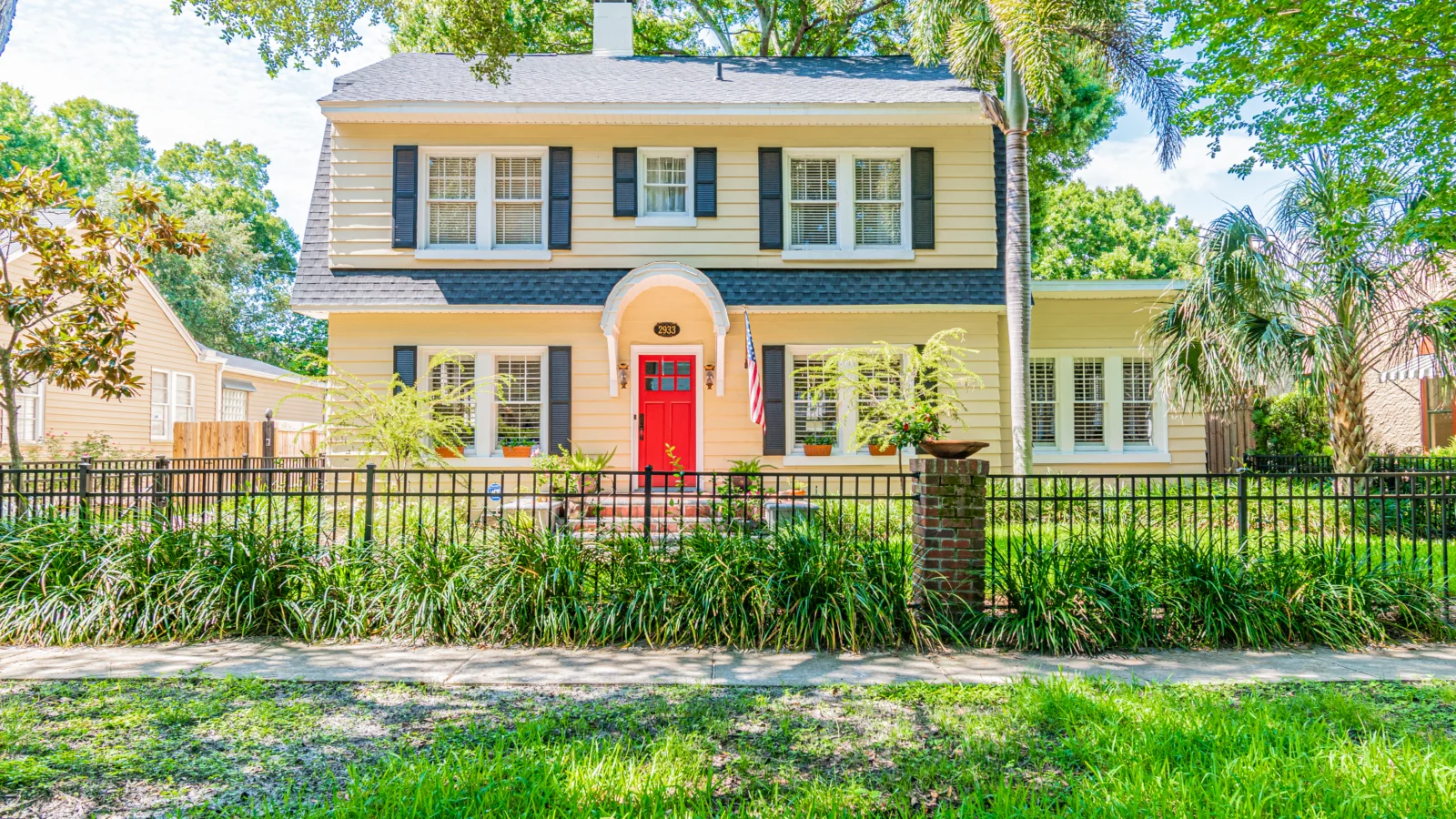
The colonial look came to Tampa early. In Hyde Park, Colonial Revival and Georgian Revival houses went up from the 1880s into the early 1900s, before the Mediterranean boom of the 1920s. The style never left. Builders still use its balanced fronts and columned entries on new homes today. This guide covers how to recognize a colonial home, where to find historic and newer examples, and what to inspect.
| Fact | Value |
|---|---|
| Active colonial-style listings | [MLS: count] |
| Median sold price, trailing 12 months | [MLS: $] |
| Median year built of sales | [MLS: year] |
| Median days on market | [MLS: days] |
How to recognize a colonial home
- A symmetrical front with the door in the center
- Two stories with a side-gable or hip roof
- Columns, a portico, or a pediment over the entry
- Multi-pane windows, often with shutters
- Wood siding or brick on historic homes; stucco, siding, or brick on newer homes
You also see related names: Georgian Revival, which is more formal and often brick; Dutch Colonial, with a gambrel roof; and Federal, with a fanlight over the door. Many newer homes in the MLS are listed as Traditional or Transitional but follow colonial proportions.
Where to find colonial homes
Hyde Park
Hyde Park has the oldest examples in Tampa. The Hyde Park Historic District, listed on the National Register in 1985, covers homes from 1886 to 1933, mostly revival styles and bungalows. Examples include the 1890 T.C. Taliaferro House, a Classical Revival listed on the National Register, and the 1882 O.J. Spafford House on Plant Avenue.
The Old Northeast
In St. Petersburg, the Old Northeast mixes Colonial Revival homes with Craftsman bungalows, Mediterranean Revival homes, and Prairie-style houses on brick streets.
Newer colonial homes
Across South Tampa, including Palma Ceia, Beach Park, and Bayshore Beautiful, many two-story homes use colonial and Georgian forms with modern plans. Compare two of these neighborhoods in Hyde Park vs. Palma Ceia.
What to check before you buy
- Wood and termites. Historic frame homes need a wood-destroying organism report. See WDO reports.
- Foundation. Many older homes sit on piers with a crawlspace. Check for level floors and sound supports.
- Systems. Check wiring, plumbing, and roof age. See 4-point inspections.
- Historic review. In Hyde Park, exterior changes and additions need a Certificate of Appropriateness from the City of Tampa’s Architectural Review Commission. See buying a historic home in South Tampa.
For sellers
Buyers of historic colonial homes want proof of care: roof, wiring, plumbing, and termite records. Buyers of newer colonial homes compare builders and finishes. Shane Vanderson prices against the right group for your home. Start with a home valuation.
To see colonial homes for sale, call or text Shane at 813-205-5430 or use the contact page.
Frequently asked questions
What is the difference between Colonial and Colonial Revival?
Colonial refers to homes built in the American colonies before about 1780. Colonial Revival homes copy that look and were built from the late 1800s on. In Tampa Bay, historic colonial homes are Colonial Revival.
Where are historic colonial homes in Tampa?
Hyde Park has the main group. Its National Register district covers homes from 1886 to 1933, including Colonial Revival and Georgian Revival houses.
Can I add on to a colonial home in Hyde Park?
Often yes, with approval. The City of Tampa’s Architectural Review Commission reviews additions in Hyde Park for scale, massing, and materials, then issues a Certificate of Appropriateness.