
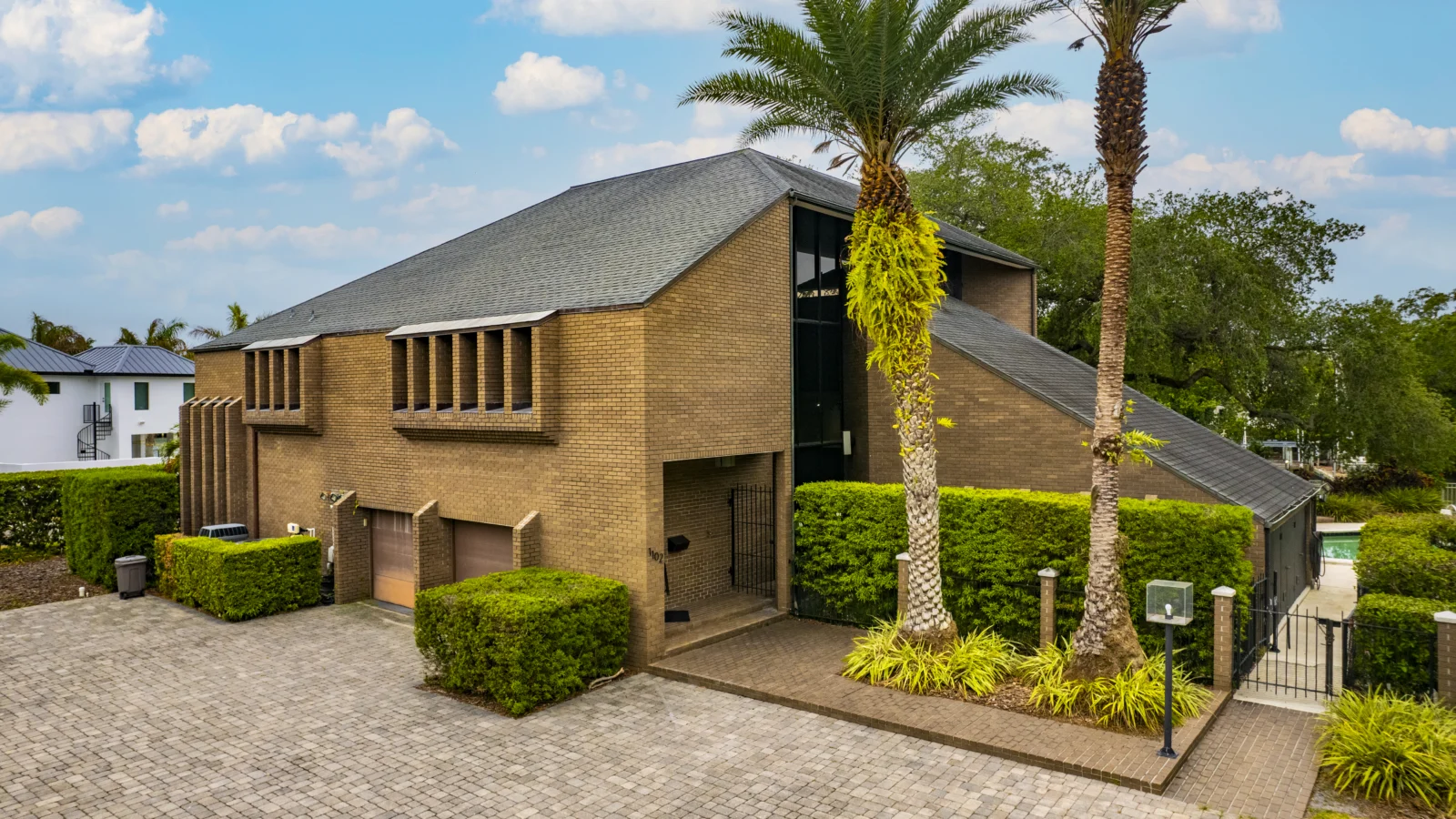
After World War II, Florida architects tried new materials and simple forms built for heat and light. A group working along the Gulf coast became known as the Sarasota School of Architecture. Tampa had its own modernists, including Mark Hampton, who ran his own firm in Tampa from 1952 to 1965. Many of the homes from this period are now valued for their design, and many sit on land that builders want. This guide explains what to look for and what to weigh.
| Fact | Value |
|---|---|
| Active mid-century modern listings | [MLS: count] |
| Median sold price, trailing 12 months | [MLS: $] |
| Median sold price per square foot | [MLS: $/sq ft] |
| Median days on market | [MLS: days] |
How to recognize a mid-century modern home
- Flat, butterfly, or low-pitch roofs with wide overhangs for shade
- Walls of glass, sliding doors, and clerestory windows high on the wall
- Open plans with few interior walls
- Concrete block, breeze block screens, and terrazzo floors
- A single story on a slab, set low to the ground
The Sarasota School is a Florida subtype of the style. Its architects, including Paul Rudolph, Ralph Twitchell, Jack West, Gene Leedy, and Victor Lundy, designed for cross breezes, shade, and light.
Where to find mid-century homes
In St. Petersburg, look in Shore Acres and Venetian Isles, and on Snell Isle, where mid-century homes sit between the 1920s houses and new builds. In Tampa, you find mid-century homes on Davis Islands and in South Tampa neighborhoods that grew after the war, such as parts of Beach Park, Sunset Park, and Bayshore Beautiful.
Restore, renovate, or rebuild
Many mid-century homes sit low on large lots. That makes them targets for teardowns, and it makes renovation planning harder in a flood zone. Under the FEMA 50% rule, if work in a Special Flood Hazard Area costs 50% or more of the building’s market value, the whole house must meet current flood rules. For a low slab home, that can mean raising it or starting over. Read the FEMA 50% rule before you set a budget.
What to check before you buy
- Roof. Flat and low-pitch roofs need a sound membrane and good drainage.
- Windows. Original single-pane glass and jalousie windows are not impact rated. Replacement can change the look, so plan it with care.
- Systems. Check wiring, plumbing, and HVAC age. See 4-point inspections.
- Elevation. Get the elevation certificate and an insurance quote early.
- Floors. Original terrazzo can often be restored. Check for cracks and patches under flooring.
For sellers
A mid-century home can sell to two different buyers: one who wants the design and one who wants the lot. Shane Vanderson prices it both ways and markets to the buyer who pays more. Start with a home valuation.
To see mid-century modern homes for sale, call or text Shane at 813-205-5430 or use the contact page.
Frequently asked questions
What makes a home mid-century modern?
A build date from about the late 1940s to the 1960s, plus the design: low roofs with deep overhangs, large glass, open plans, and a close link between inside and outside.
What is the Sarasota School of Architecture?
A group of Florida modernists, including Paul Rudolph, Ralph Twitchell, Jack West, Gene Leedy, and Victor Lundy, who adapted mid-century design to the Gulf coast climate with shade, cross ventilation, and light.
Where are mid-century modern homes in St. Petersburg?
Northeast St. Petersburg has the most, in Shore Acres, Venetian Isles, and on Snell Isle.
Can I renovate a mid-century home in a flood zone?
Yes, but watch the FEMA 50% rule. If the work costs 50% or more of the building’s market value, the home must meet current flood rules. Get a cost estimate and talk to the city’s floodplain office before you buy.