Quick answer
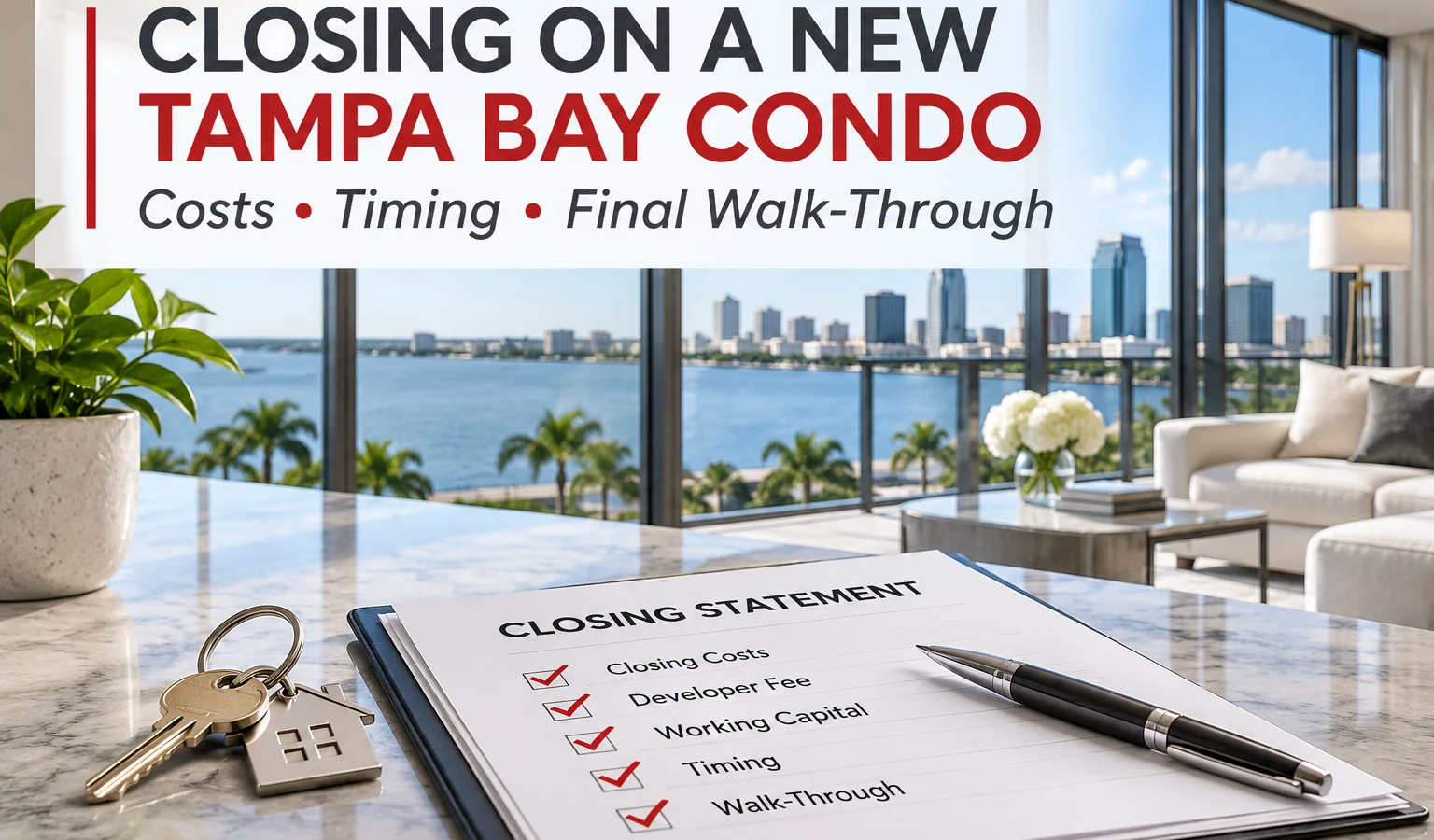
On a developer sale in Tampa Bay, the purchase agreement decides who pays what, not the resale custom. Buyers cover deed doc stamps at $0.70 per $100, the owner's title policy, any developer closing fee the contract sets, and a working-capital contribution to the new association. Check the statement against the prospectus schedule, then walk the unit before you wire.
If you signed a contract at Pendry Residences Tampa, ONE Tampa, or the second tower at The Ritz-Carlton Residences, Tampa, your closing is no longer theoretical. Related Group announced in April that Tower II on Bayshore was welcoming residents. Two Roads Development says Pendry opens in 2027. Kolter Urban expects ONE Tampa closings to begin in the third quarter of 2027. Across the bay, 400 Central and Art House are still closing contracts their buyers signed in 2022 and 2023.
Somewhere in that window, the developer’s closing agent sends you an estimated closing statement, and it won’t look like the one your neighbor saw on a Hyde Park resale. The doc stamps sit on your side. The title agent is one you didn’t choose. There’s a developer fee, a working-capital line for an association that doesn’t have an elected board yet, and a closing date you don’t control.
Here’s how to read it, which lines are statutory and which are contractual, and what to confirm in the unit before you wire.
Who pays what on a developer sale, and why it isn’t the resale custom
On a Tampa Bay resale, the FAR/BAR contract follows a custom: the seller pays the documentary stamp tax on the deed, and in Hillsborough and Pinellas the buyer pays for and selects the owner’s title policy. Developer contracts aren’t FAR/BAR forms. The developer’s counsel writes them, and the cost allocation is whatever the agreement says.
Florida law does make the developer show its work. Under section 718.504(22), the prospectus you received with your contract must include a schedule of the estimated closing expenses the buyer pays, and a statement of whether title insurance is available and at whose expense. Pull that schedule out now and set it beside the estimated statement. The two should match line for line, and anything that doesn’t is your first question to the closing agent.
The lines that surprise buyers most:
- Deed doc stamps, shifted to you. The rate in Hillsborough and Pinellas is $0.70 per $100 of price. On a $1.7 million residence, that’s $11,900 a seller would customarily pay on a resale and a developer contract usually assigns to the buyer. The tax is fixed by the state; the payer was negotiable only before you signed.
- The owner’s title policy, through the developer’s agent. You’d buy the owner’s policy on a Hillsborough or Pinellas resale anyway, but on a developer sale you use the developer’s closing agent, and the contract often ties any closing-cost credit to that choice. Florida’s promulgated premium on $1.7 million works out to about $6,825 ($5.75 per $1,000 on the first $100,000, $5.00 per $1,000 up to $1 million, and $2.50 per $1,000 above that), plus the agent’s search and settlement fees. Don’t economize here: on a new building the title risk is construction liens from unpaid subcontractors and the developer’s own chain of title, which is a different problem from a forgotten mortgage on a resale. My post on title insurance in Florida covers what the policy does and doesn’t do.
- The developer closing fee. Some contracts call it a developer fee, some an administrative or closing fee, some a contribution toward the developer’s closing costs. It’s set in the contract as a percentage of price or a flat amount, and it exists because the developer’s counsel put it there. If your schedule shows one at 1.5%, that’s $25,500 on $1.7 million. It’s the most negotiable line in the agreement, and the moment to negotiate it was at signing. At closing, your leverage is the developer’s interest in closing you on time.
- The working-capital contribution. A new association has no reserves and no operating history, so the declaration typically requires each first buyer to fund a contribution at closing, commonly sized at two or three months of assessments, sometimes a flat figure or a percentage of price. On an $1,800 monthly assessment, two months is $3,600. Chapter 718 restricts what the developer may do with that money while it’s still excused from paying assessments on unsold units; the funds belong to the association, not to the developer’s operating shortfall. Ask the closing agent to show you where the contribution lands on the association’s books.
- Prorations that don’t behave like a resale. Assessments start the day you close, at the budgeted figure, under the statute’s own disclaimer that actual costs may exceed the estimate. Property taxes are prorated on the current bill, and the first bill that values your unit as a finished residence may not arrive until the year after the building is complete. Budget for that step up rather than treating the first prorated figure as your run rate.
- Financing taxes, if you borrow. Doc stamps on the note run $0.35 per $100 of the loan amount, and the intangible tax is $0.002 per dollar. On a $1 million mortgage that’s $3,500 and $2,000 before lender fees.
Add it up on a $1.7 million cash purchase with a 1.5% developer fee and a two-month contribution, and the buyer-side total lands near $48,000, close to 3% of price, before the closing agent’s own fees. The same unit bought as a resale would run under 1% for a cash buyer. That gap is the number to know before you wire, and it’s why the schedule in your prospectus matters more than any blog estimate, including this one.
The closing date belongs to the developer, and your financing has to survive it
Developer contracts don’t set a closing date. They set a mechanism: once the building has a certificate of occupancy (or a temporary one covering your floor), the developer sends notice, and you close within a stated number of days of that notice, often two to four weeks. Failed inspections, elevator certifications, and utility connections move the date, and the contract’s Outside Date is the only hard stop. If you want a refresher on how that date protects your deposit, it’s in my post on pre-construction condo deposits in Tampa Bay.
Three things follow for buyers closing in 2026 and 2027:
- Most developer contracts have no financing or appraisal contingency. If you signed in 2022 or 2023 and the lender’s appraiser values the unit below your contract price in 2027, the shortfall is cash you bring to the table, not grounds to cancel. Downtown St. Petersburg is showing why that matters: the St. Pete Catalyst reported on November 5 that a developer-owned three-bedroom at 400 Central closed $90,000 below asking, and that developers there are offering closing credits to move remaining units. Your appraiser will see those comps.
- Your lender has to approve the building, not just you. A condominium with the developer still in control, unsold inventory, and no operating history is a project-review question for every lender, and the agency rules tightened in 2026. Many buyers at this price point use a portfolio or jumbo lender that underwrites the project itself. Start that conversation 90 days before you expect notice, not after it arrives. Rate locks long enough to cover a moving CO date exist, and they cost money; price one against the risk of floating.
- The 15-day cancellation right is long gone. Section 718.503 gave you 15 days after signing and after receiving the condominium documents, plus a fresh 15 days after any amendment that materially and adversely changes the offering. If the developer sends an amended budget or a revised declaration before closing, read it against that standard with your attorney before the window runs; outside those windows, the contract governs.
The negotiation posture here is different from a resale. The developer wants you to close. With Tampa’s condo supply at 7.3 months in October and buyers holding more leverage than they did in 2022, developers have shown they’ll move on credits and timing to keep a closing on the calendar. Ask, in writing, and tie any concession to a specific line on the statement.
The walk-through, the paperwork, and what to confirm before you wire
You’ll be offered a pre-closing walk-through. Treat it as the inspection the contract didn’t give you.
- Bring your own inspector if the contract allows it, and ask in advance if it’s silent. Punch-list items are cosmetic defects, incomplete installations, and finishes that don’t match the specification you signed. Photograph everything and get the developer’s punch list in writing with completion dates.
- Ask about a holdback. Most developers resist escrowing funds for open items, but the answer tells you how much weight your list carries after you own the unit. Florida’s condominium statute gives first buyers implied warranties on the unit and the building for defined periods after completion; cosmetic items are the ones that get lost, so document them.
- Compare the final budget to the one in your prospectus. Monthly assessments on new Tampa Bay towers commonly land between $1.50 and $2.00 per square foot. If the number moved, understand why. Insurance is the usual answer, and a cost increase alone isn’t a material adverse change under the statute’s disclaimer.
- Read the structural integrity reserve study statement. Since the 2024 reforms, the developer must deliver the most recent SIRS or a statement that none has been completed. For a new building it’s usually the latter, and it tells you when the first study is due and who pays for it.
- Line up insurance before the notice of closing. Your lender will want an HO-6 policy and the association’s master-policy certificate. On a new building the master policy may be bound days before the first closings, so ask the closing agent for the certificate early.
- Decide how you’ll take title. Tenancy by the entireties, a trust, or an entity each change your homestead and estate position, and the closing agent records whatever you instruct. The trade-offs are in how to take title to a Tampa Bay luxury home.
- Verify wire instructions by phone, on a number you already have. Developer closings are high-value, scheduled, and publicized, which makes them targets. The protocol is in my post on wire fraud at a Tampa Bay closing.
None of this is a reason to dread the closing. Buyers in this wave are getting buildings that didn’t exist in Tampa five years ago, and 2026 and 2027 are the years that show whether downtown’s condo market works at this scale. It is a reason to read the statement the way you’d read a resale inspection report: line by line, with the contract and the prospectus open beside it. If the front half of that contract is still fresh, the deposit, upgrade, and warranty terms are covered in luxury new construction contracts in Tampa Bay.
Frequently Asked Questions
Who pays the documentary stamp tax on a new-construction condo in Florida?
Whoever the developer's purchase agreement says, and in Tampa Bay that is usually the buyer. On a resale, the seller customarily pays the deed stamps under the FAR/BAR contract. The rate in Hillsborough and Pinellas counties is $0.70 per $100 of the purchase price, so a $2 million residence carries $14,000 in deed stamps regardless of who pays.
What is a developer fee at a condo closing, and can I negotiate it?
A developer fee is a charge the developer's contract adds at closing, set as a percentage of price or a flat amount, to cover the developer's closing and administrative costs. Florida requires it to appear in the prospectus schedule of estimated closing expenses under section 718.504(22). It is negotiable at contract signing; at closing, your leverage is limited to the developer's interest in closing on schedule and whatever credits it is offering to move remaining units.
What is a working-capital contribution, and do I get it back?
It is an initial payment to the new condominium association, typically two or three months of assessments, collected from each first buyer at closing so the association has operating cash before it has a history. It is usually not refundable unless the condominium documents say otherwise. Florida law restricts the developer from using it to cover its own operating obligations, and on a later resale a Florida condo association cannot charge a capital contribution at all.
Can the developer delay my closing, and can I cancel if it does?
Yes, within limits. Developer contracts tie closing to the certificate of occupancy and a notice period rather than a fixed date, so the date moves with construction. Your protection is the contract's Outside Date, after which you can cancel and recover your deposit, and the 15-day window under section 718.503 to cancel after any amendment that materially and adversely changes the offering. A delay by itself, before the Outside Date, is not grounds to cancel.
Can I get a mortgage on a brand-new Tampa Bay condo if the appraisal comes in low?
You can get the mortgage, but the developer contract almost never includes a financing or appraisal contingency, so a low appraisal means you bring the difference in cash or forfeit your deposit. The lender also has to approve the building, which means a project review of presale levels, budget, insurance, and developer control. Start with a lender 90 days before you expect the notice of closing, and ask about a rate lock long enough to cover a moving completion date.
Before you wire
A developer closing statement is readable once you know which lines come from the statute, which come from the contract, and which the developer can still move. If your notice of closing is coming at Pendry, ONE Tampa, The Ritz-Carlton Residences, or one of the St. Petersburg towers and you want a second set of eyes on the closing statement, the association budget, or a contract term before you wire, reach out at 813-205-5430 or shane.vanderson@engelvoelkers.com.
This article is general information for Tampa Bay buyers and sellers, not insurance or legal advice. Policy terms, carrier underwriting rules, and court rulings change; confirm coverage questions with a licensed Florida insurance agent and contract questions with a Florida real estate attorney.
About Shane Vanderson
Shane Vanderson is a Broker Associate and License Partner with Engel & Völkers South Tampa, licensed in Florida since 2012 and specializing in luxury and waterfront residential real estate, condos, and new construction across Tampa Bay. He advises buyers and sellers across South Tampa, Downtown Tampa, St. Petersburg, and the beaches, and is part of the Engel & Völkers Professional Athlete Advisory program. Reach him at 813-205-5430 or shane.vanderson@engelvoelkers.com.