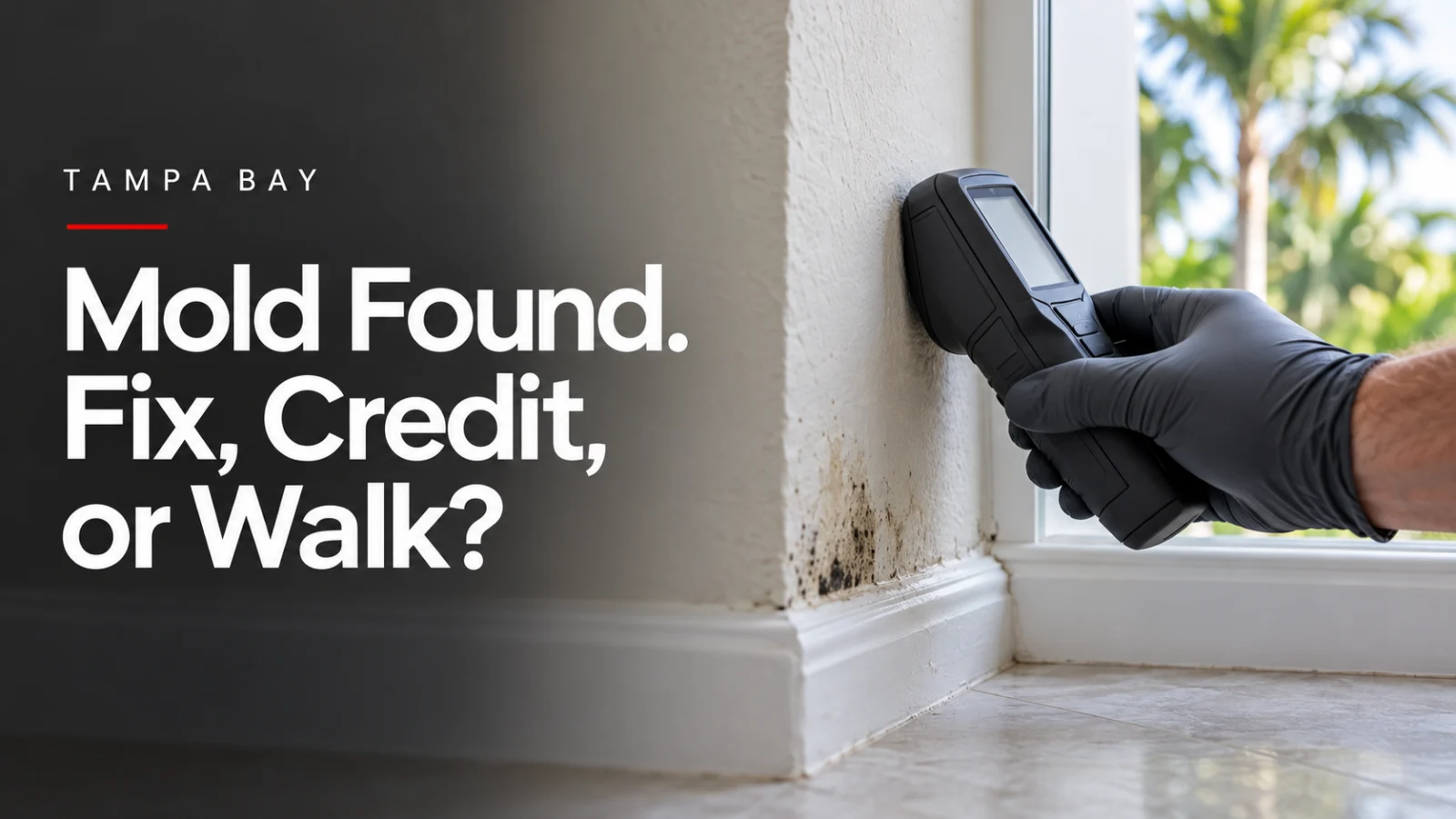
What should you do when a home inspection in Tampa Bay finds mold?
Quick answer
Treat it as a water problem first and a mold problem second. In Florida, mold growth of more than 10 square feet must be assessed and remediated by state-licensed professionals, and the same company can’t do both jobs on the same house. Order a licensed mold assessment inside your inspection period, get a remediation quote based on that report, and then decide: a seller repair with clearance testing, a credit, or cancellation under the AS IS contract. Most contained bathroom or air-handler cases in Tampa Bay run a few thousand dollars; whole-house cases after flooding can pass $35,000. Sellers who have had water in the house must disclose what they know, including mold they removed themselves.
Two years after Helene and Milton, a lot of Tampa Bay homes that took water are back on the market. Some were remediated by licensed crews with clearance reports. Some were dried with box fans and a four-foot drywall cut. From the street, and often from the living room, they look the same.
That’s why “the inspector found mold — do we walk?” is one of the most common questions I’m hearing from buyers right now, and why it fills threads on r/tampa and r/StPetersburgFL. One St. Pete owner found “black mold that had been under the vinyl flooring for a long time.” A buyer on r/FirstTimeHomeBuyer put it bluntly: “if I find issues significant enough that I have to ask if I should walk, then the answer is yes.”
That instinct is understandable. It’s also usually too fast. Here’s how I walk clients through it.
Who tests, who fixes, and why your home inspector isn’t either
Start with a distinction the inspection report won’t make for you: a standard Florida home inspection is a visual inspection. Most home inspectors are not licensed to assess mold, and the better ones say so. What you’ll see on the report is language like “evidence of moisture staining, recommend further evaluation by a licensed professional.” That line is your cue, not your answer.
Florida regulates mold work under Chapter 468, Part XVI of the Florida Statutes, and three rules matter to you as a buyer or seller:
- The 10-square-foot line. The statute defines mold assessment and remediation as work involving mold growth of more than 10 square feet. Above that, the person assessing must hold a Florida mold assessor license, and the person removing it must hold a mold remediator license. Both are checkable on the DBPR license search.
- The 12-month separation. A licensed assessor cannot remediate a structure that the assessor, or the assessor’s company, assessed within the past 12 months, and a remediator cannot assess a structure it remediated in that window. Referral fees between the two are prohibited. In practice: the company that tells you how bad it is should not be the company that bids the cleanup.
- The owner exemption. A residential owner may assess or remediate their own property without a license. That is why so many post-storm homes were handled by the owner. It’s legal. It’s also why buyers’ assessors keep finding moisture above the cut line.
A licensed assessment in Tampa Bay typically starts with a moisture survey and air samples taken in several rooms and compared with an outdoor baseline. Local assessors commonly quote $325 to $550 for a single-family home, with air samples around $40 to $100 each and a post-hurricane whole-house assessment in the $750 to $1,800 range. Treat those as the ranges being quoted around the market, not a price list — your home’s size and history drive the number.
What you’re buying with that fee is a report that answers four questions: Is there active mold growth? Where? What is the water source? Is the source still active? A report that answers all four is what a remediator needs to write a real scope, what your insurance carrier will want if you ever file a claim, and what a seller needs to disclose accurately.
Schedule it early. Under the FAR/BAR AS IS contract, your inspection period is typically 10 to 15 days, and an assessment plus lab results plus a remediation quote can take most of that. If the assessor can’t get in until day eight, ask for an extension in writing before the deadline, not after.
What remediation actually costs in Tampa Bay, and what insurance does and doesn’t cover
The number depends almost entirely on scope, and scope depends on the water source.
Here are the ranges licensed Tampa Bay remediators and assessors are quoting in 2026, which match what I’ve seen on recent contracts:
- Contained bathroom or closet (a single leak, one wall cavity): roughly $1,800 to $3,500.
- Air handler and ductwork decontamination: roughly $2,500 to $7,500. This one is common in homes where the AC was off for weeks after a storm.
- Multiple wall cavities after flood intrusion, larger homes: $35,000 and up.
- Post-remediation clearance testing by a separate licensed assessor: roughly $300 to $500.
Remediation itself is usually fast — days, not weeks. What takes time is finding and fixing the water source. Mold grows where water is. If the leak, the grading, the window flashing, or the humidity problem isn’t fixed, the mold returns and you’ve paid twice.
Two local details worth knowing. First, after Helene and Milton, the standard flood cut was four feet of drywall. Moisture wicks up the paper face above the waterline, and remediators on r/tampa were blunt about it: “You don’t remove what got wet, you remove a foot over.” If the house you’re buying had a four-foot cut and a repaint, your assessor should sample above that line. Second, slab homes with tile over the original subfloor can hide moisture under the flooring for years. The St. Pete owner who found mold under vinyl isn’t unusual.
On insurance, go in with realistic expectations. Florida homeowners policies generally cover mold only when it results from a sudden, covered water loss — a burst supply line, a storm-created opening. Mold from a slow leak, poor ventilation, or indoor humidity is treated as a maintenance exclusion. And even covered mold is usually capped. Florida Peninsula, for example, includes $10,000 of mold remediation coverage on its standard policy and offers buy-ups to $25,000 or $50,000. Other carriers structure it differently, and Citizens policyholders who decline its Managed Repair Program carry a separate $10,000 limit on non-weather water losses. Flood damage is a different policy entirely.
For a buyer, that means the seller’s insurance is not your remediation budget. For a seller, it means a past claim — and its payout cap — is part of the story a buyer’s assessor will reconstruct. If you want the pattern across a home’s claims history, the CLUE report is where it shows up.
Fix, credit, or walk: how to decide inside the inspection period
Once you have the assessment and a remediation quote, you have three real options and a deadline. Here’s how I frame each one.
1. Seller remediates before closing, with clearance.
This works when the source is clear, the scope is contained, and the seller has time. Make the terms specific in the addendum: a licensed remediator, a written scope matching the assessment, a separate licensed assessor’s clearance report before closing, and copies of all three to you. Do not accept “seller will treat the area” or a handyman invoice. The point of clearance testing is that someone other than the person who did the work confirms it worked.
Where this falls short: the seller controls the vendor and the schedule, and if the source turns out to be bigger than the quote, you’re negotiating again a week before closing.
2. You take a credit or price reduction and manage it yourself.
This is the option most buyers on BiggerPockets and Reddit were steered toward, and for good reason. You pick the remediator, you control the scope, and you can bundle the work with renovations you were already planning. The negotiation lever is the written quote: “Get a reasonable quote and a price reduction,” as one investor put it. Expect a split rather than full coverage from the seller, and be realistic about what a credit can be used for under your loan program — some lenders cap seller credits, and a price reduction may serve you better on a jumbo loan.
Where this falls short: you own the problem the day you close. If you’re financing, your lender may require remediation before funding when the mold is extensive or the appraiser notes it.
3. You cancel.
Under the AS IS contract, you can cancel for any reason inside the inspection period and get your deposit back. Walk when the water source can’t be identified, when the assessment shows elevated readings in most rooms with no obvious cause, when there’s evidence the home was flooded and remediated without documentation, or when the seller refuses to allow sampling. A mold problem with no identified source isn’t a $5,000 problem. It’s an unknown.
What I tell buyers who are torn: a documented, contained problem with a priced fix is a negotiation, not a reason to leave. An undocumented history is the thing to walk away from. For more on the broader call, see should you waive the inspection on a Tampa Bay luxury home. The short answer is still no.
If you’re the seller: disclosure, pre-listing testing, and the four-foot mistake
Mold is a disclosure issue before it’s a repair issue. Florida’s Johnson v. Davis rule requires sellers to disclose known material defects that aren’t readily observable, and the Florida Realtors Seller’s Property Disclosure asks directly about water intrusion, moisture, and mold. Since 2024, sellers must also complete Florida’s flood disclosure.
The guidance from Florida real estate attorneys is consistent: if you had mold and removed it yourself, you still disclose it and say that you removed it. If you don’t know, mark “Don’t Know” rather than guess. Writing “No” when you’ve had a known water event is the fact pattern that produces post-closing lawsuits.
If your home took water in 2024, the question I ask every seller is simple: who did the work, and do you have paper? A licensed remediator’s invoice, a scope, and a clearance report from a separate assessor turn a liability into a disclosure that reassures buyers. A four-foot cut, a DIY dry-out, and a fresh coat of paint do the opposite, because the buyer’s assessor will sample above the line. If you’re in one of the neighborhoods that flooded in Helene, assume every serious buyer will test.
For sellers without documentation, a pre-listing assessment is often worth the few hundred dollars. If it’s clean, you’ve removed a negotiating point before it exists. If it isn’t, you fix it on your schedule with your vendor rather than under a 15-day clock with a buyer’s remediator setting the price.
One more thing: a licensed assessment and clearance report don’t just protect the sale. They protect the price. Buyers pay less for uncertainty than they pay for a problem with a receipt.
Frequently Asked Questions
Does a Florida home inspector test for mold?
Usually not. A standard home inspection is visual, and mold assessment is a separate state license under Chapter 468 of the Florida Statutes. Some inspectors hold both licenses; most will note moisture evidence and recommend a licensed mold assessor. Ask before you book.
How much does a mold inspection cost in Tampa?
Licensed assessors in the Tampa Bay area commonly quote $325 to $550 for a single-family home, plus $40 to $100 per air sample. A full post-flood assessment of a larger home runs higher, often $750 to $1,800. Lab results typically take a few business days, so schedule it in the first half of your inspection period.
Can I cancel a Florida AS IS contract because of mold?
Yes, if you’re still inside your inspection period. The FAR/BAR AS IS contract lets the buyer cancel for any reason during that window and recover the deposit. After the period ends, your options depend on the seller’s willingness to negotiate, so get the assessment and quotes done before the deadline or request an extension in writing.
Does homeowners insurance cover mold in Florida?
Only in limited cases. Most Florida policies cover mold that results from a sudden, covered water loss, and exclude mold from slow leaks, humidity, or poor ventilation. Even covered mold is typically capped — $10,000 is a common limit, with buy-up options to $25,000 or $50,000 on some carriers. Flood-related mold falls under flood insurance, not the homeowners policy.
Do I have to disclose mold that I already removed?
Yes. Florida’s duty to disclose covers known material defects, and the Seller’s Property Disclosure asks about moisture and mold. Disclose the event, what was done, and who did it. If a licensed remediator did the work and a separate assessor issued a clearance report, include both — that documentation is what turns a past problem into a non-issue for most buyers.
What this means for your sale or purchase
Mold in a Tampa Bay home is a water question with a price attached. Find the source, price the fix with licensed professionals, and decide inside your inspection period. For sellers, the same logic runs in reverse: document what happened, disclose it, and get ahead of the buyer’s assessor.
If you’re weighing a sale, start with a current valuation of your home — not an algorithm’s guess, but a number grounded in what’s actually closing in your neighborhood and building, including how a past water event or a clearance report affects it. Request yours at shanevanderson.com/evaluation, or call 813-205-5430.
About Shane Vanderson
Shane Vanderson is a Broker Associate and License Partner with Engel & Völkers South Tampa, licensed in Florida since 2012 and specializing in luxury and waterfront residential real estate, condos, and new construction across Tampa Bay. He advises buyers and sellers across South Tampa, Downtown Tampa, St. Petersburg, and the beaches, and is part of the Engel & Völkers Professional Athlete Advisory program. Reach him at 813-205-5430 or shane.vanderson@engelvoelkers.com.