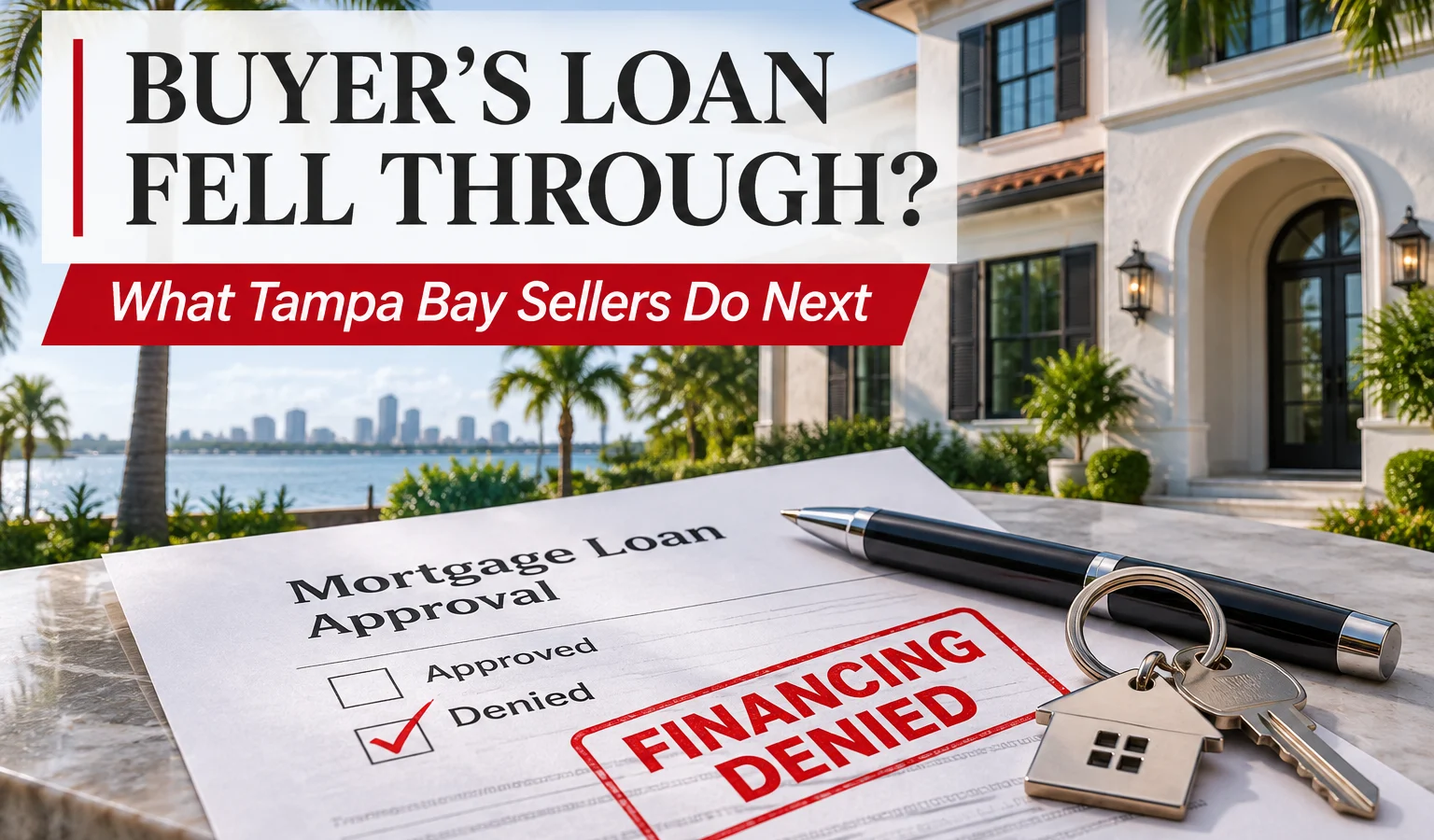
What happens when a buyer’s financing falls through on a Tampa Bay home?
Quick answer
Under the FAR/BAR AS IS contract, a buyer who can’t get loan approval and cancels in writing before the loan approval period ends (30 days by default) gets the deposit back. A buyer who stays silent, or who sends loan approval notice and then fails to close, usually forfeits it. The seller can then relist, often within days.
Redfin’s September report put Tampa’s contract-cancellation share at 18.8% — nearly one pending sale in five — against a national 14.5% that was the highest September on record. Thirty-year rates sat above 7% through October, and jumbo loans were quoted at 7.29% this week. In that environment, a buyer’s financing is the contingency most likely to break late, and it’s the one sellers understand least.
The inspection period is the exit everyone knows about. The financing contingency is the other exit, and it has its own deadlines, its own notice rules, and a specific answer to the question every seller asks first: do I keep the deposit?
Here’s how Paragraph 8(b) works, who gets the money in each scenario, and what I tell sellers in South Tampa, Downtown Tampa, and St. Petersburg about keeping a sale alive or letting it go.
How the FAR/BAR financing contingency works
Almost every financed sale in Hillsborough and Pinellas runs on the Florida Realtors/Florida Bar AS IS contract. When the buyer checks the financing box in Paragraph 8(b), the contract becomes contingent on the buyer obtaining loan approval within the loan approval period. If the blank is left empty, that period is 30 days after the effective date. The buyer has to apply within five days and “use good faith and diligent effort” to get approved.
Two definitions matter more than any other line in the paragraph:
- Loan approval means approval of the specific loan written into the contract — amount, type, rate cap, and term — plus an appraisal or alternative valuation “satisfactory to lender” if the lender requires one. A pre-approval letter is not loan approval. Neither is a conditional approval with income or asset conditions still open.
- Written notice means a letter or an email from the buyer, the buyer’s agent, or the buyer’s attorney, delivered before the period expires. A phone call from the loan officer doesn’t count.
Before the period ends, the buyer has three options:
- Send loan approval notice. The financing contingency is satisfied, and the deposit is now governed by Paragraph 8(b)(vi), which I’ll cover below.
- Cancel in writing. If the buyer can’t get loan approval and isn’t otherwise in default, the buyer “shall be refunded the Deposit.” The contract doesn’t require proof of denial, though a denial letter ends most arguments.
- Say nothing. This is where sellers get surprised. If the deadline passes with no notice, the contract proceeds as though it were a cash deal — the buyer has waived the protection. The seller then has three days after the period ends to terminate in writing and return the deposit. Miss that window, and you’re bound to a buyer whose loan status you may not know.
That third path is a live question in Florida legal columns: a seller four weeks into a 30-day period, buyer silent, title company hearing nothing, two higher offers waiting. The answer is yes, the seller can terminate inside the three-day window and move on. The practical rule: calendar day 30 and day 33 the moment the contract goes effective, and send a written status request under 8(b)(ii) around day 15.
One more detail from the Florida Realtors legal team: “Financing” means the loan described in the contract. A buyer who switches from conventional to FHA, or from a 30-year fixed to a different product, may have stepped outside the contingency without realizing it.
Who gets the deposit — four scenarios
On a $2 million South Tampa home with the customary 1% escrow deposit, the question is worth $20,000. Here’s how the contract resolves the common cases. (The earnest money post covers how deposits are sized and held; this is about what happens when financing is the reason the deal dies.)
- Loan denied on day 25, buyer cancels in writing on day 26. Deposit returns to the buyer. The listing goes back to active the same week.
- Buyer silent through day 30, seller doesn’t terminate, loan dies on day 40. The contract became a cash deal on day 30. A buyer who can’t close is in default under Paragraph 15(a), and the seller can keep the deposit as liquidated damages or pursue the buyer in court. The retained deposit is shared with the brokers under the contract’s split, capped at the commission the listing broker agreed to pay.
- Buyer sent loan approval notice on day 28, lender pulls out two days before closing. Paragraph 8(b)(vi) says the deposit “shall be paid to Seller” unless the failure to close comes from the seller’s default or from an unmet property-related condition of the loan — a roof the lender wanted replaced, a condo building that failed the lender’s project review, an insurance binder the lender couldn’t accept. Appraised value is specifically excluded from those property-related conditions.
- Appraisal came in low. Inside the loan approval period, a low appraisal that the lender won’t lend on means the buyer hasn’t obtained loan approval and can cancel for a full refund. After loan approval notice, value is no longer an exit. Buyers who want value protection after that point need the separate appraisal contingency addendum, and sellers should know whether it’s attached before they count on the deposit.
When the parties disagree, the title agent holding escrow won’t release it to either side without both signatures or a court order. The contract gives the parties 10 days to work it out, then requires mediation before anyone files suit, and the prevailing party in litigation recovers attorney’s fees. At $20,000 and up, a one-hour consult with a Florida real estate attorney before you sign a release is money well spent.
Keep the sale alive, or let it go?
Most financing problems surface as a request for more time, not a cancellation. How you answer depends on what’s wrong with the loan.
The contract extends itself only in one narrow case. Paragraph 5(a) pushes the closing date automatically, for up to seven days, when the lender can’t fund on time because of federal Closing Disclosure timing — and only if loan approval has been obtained and underwriting is complete. Attorneys’ Title Fund Services (The Fund) describes it as never intended to be “a general backstop protection for buyers with respect to mortgage lender missteps.” Every other delay needs a signed extension addendum, and extending the closing date does not extend the loan approval period.
Before agreeing to an extension, ask for three things in writing from the lender: the current approval status, the list of open conditions, and which of those conditions are the buyer’s (income, assets, reserves) versus the property’s (repairs, insurance, condo documents). Buyer-side conditions on a jumbo file — tax-return income lower than the pre-approval assumed, or assets that can’t be sourced — tend not to clear. Property-side conditions usually can.
If you grant time, price it. A larger deposit that becomes non-refundable at signing, or a per-day charge toward your carrying costs, keeps the buyer motivated and compensates you if the extension fails. If a stronger offer is waiting, the backup offer rider lets you lock it in without breaching the first contract.
What you actually pay again. A Tampa seller on BiggerPockets asked the question the way most sellers think it: “What costs does a seller incur every single time the same house goes under contract?” Less than you’d expect. The seller customarily selects the title agent in Hillsborough and Pinellas, and title work is generally paid once at closing, so the same title company on the next contract rarely means a second search fee. A condo or HOA estoppel certificate is valid for a limited period and may need to be reordered. The buyer paid for the inspections and appraisal. The real cost is time: another two to six weeks of taxes, insurance, and mortgage interest on a home that was supposed to be sold, in a market where downtown St. Petersburg listings are sitting a median of 118 days.
When the listing goes back to active, how the MLS status is handled affects what the next buyer sees. The relisting post walks through the status choices and the days-on-market consequences.
Screen the next buyer so it doesn’t happen twice
A failed financing contingency is a signal about the offer you accepted, not just bad luck. Here’s what I check before a seller signs the next one:
- Pre-approval versus underwritten approval. Ask whether the lender has underwritten the buyer’s income and assets or only run credit. On loans above the conforming limit, lender overlays — extra reserve months, stricter debt-to-income caps, asset-sourcing rules — are “not always obvious at preapproval.” The jumbo mortgage post explains why those files take longer and break more often.
- A shorter loan approval period. Twenty-one days instead of 30 forces the buyer’s lender to show its hand earlier and gives you more of the selling season back if it fails.
- A deposit that means something. One percent is customary here; on a financed offer above $1.5 million, a second deposit due at loan approval raises the buyer’s cost of walking.
- Written status requests on a schedule. Paragraph 8(b)(ii) obligates the buyer to keep you informed on request. Use it at day 10 and day 20.
- Cash, weighed fairly. A cash offer at a lower number can net more than a financed offer that fails in week five and costs you a month. Run both.
Every one of these is a negotiation at offer stage, not a repair after the fact. That’s where a listing agent earns the fee — reading a lender letter, pricing an extension, and knowing which conditions clear and which don’t.
Frequently Asked Questions
Does the buyer get the earnest money back if the loan is denied in Florida?
Usually yes, if the buyer applied on time, made a good-faith effort, and delivered written notice of cancellation before the FAR/BAR loan approval period expired (30 days after the effective date unless the contract says otherwise). A buyer who misses that deadline loses the financing protection, and the deposit is at risk.
Can a seller cancel if the buyer never sent loan approval?
Yes. Under Paragraph 8(b)(v) of the FAR/BAR AS IS contract, if the buyer gives no written notice before the loan approval period ends, the seller has three days after it ends to terminate in writing and return the deposit. If the seller doesn’t act within those three days, the contract continues as if it were a cash deal.
What if the buyer’s lender needs a few more days to close?
The contract extends the closing date automatically only when the lender’s Closing Disclosure timing rules are the reason, loan approval is already in hand, and underwriting is complete, and only for up to seven days. Any other delay needs a signed extension addendum. Sellers often agree in exchange for a larger non-refundable deposit or a per-day charge, and extending the closing date does not extend the loan approval period.
Does a low appraisal let a buyer cancel under the FAR/BAR contract?
Only inside the loan approval period. Loan approval under 8(b) includes an appraisal satisfactory to the lender, so a buyer whose lender won’t fund at the appraised value can cancel in writing before the deadline and recover the deposit. After the buyer has delivered loan approval notice, appraisal value is specifically excluded from the reasons that return the deposit. A separate appraisal contingency addendum changes that outcome.
What does a seller have to pay again after a sale falls through in Tampa Bay?
Usually less than sellers fear. The seller customarily selects the title agent in Hillsborough and Pinellas, and title work is generally paid once at closing, so a new contract with the same title company rarely means a second title bill. A condo or HOA estoppel certificate is valid for a limited time and may need to be reordered. The real cost is carrying the home for another two to six weeks of taxes, insurance, and interest while the listing goes back to active.
A buyer’s loan falling through is a contract problem with a contract answer: the deadline, the notice, and the paragraph that controls the deposit. Handle those three correctly and the sale either closes on an extension you priced, or it ends with the deposit in the right hands and the listing back in front of buyers within the week.
If a failed contract has you weighing whether to relist or wait, start with a current valuation of your home — not an algorithm’s guess, but a number grounded in what’s actually closing in your neighborhood and building. Request yours at shanevanderson.com/evaluation, or call 813-205-5430.
This article is general information for Tampa Bay buyers and sellers, not insurance or legal advice. Policy terms, carrier underwriting rules, and court rulings change; confirm coverage questions with a licensed Florida insurance agent and contract questions with a Florida real estate attorney.
About Shane Vanderson
Shane Vanderson is a Broker Associate and License Partner with Engel & Völkers South Tampa, licensed in Florida since 2012 and specializing in luxury and waterfront residential real estate, condos, and new construction across Tampa Bay. He advises buyers and sellers across South Tampa, Downtown Tampa, St. Petersburg, and the beaches, and is part of the Engel & Völkers Professional Athlete Advisory program. Reach him at 813-205-5430 or shane.vanderson@engelvoelkers.com.