Quick answer
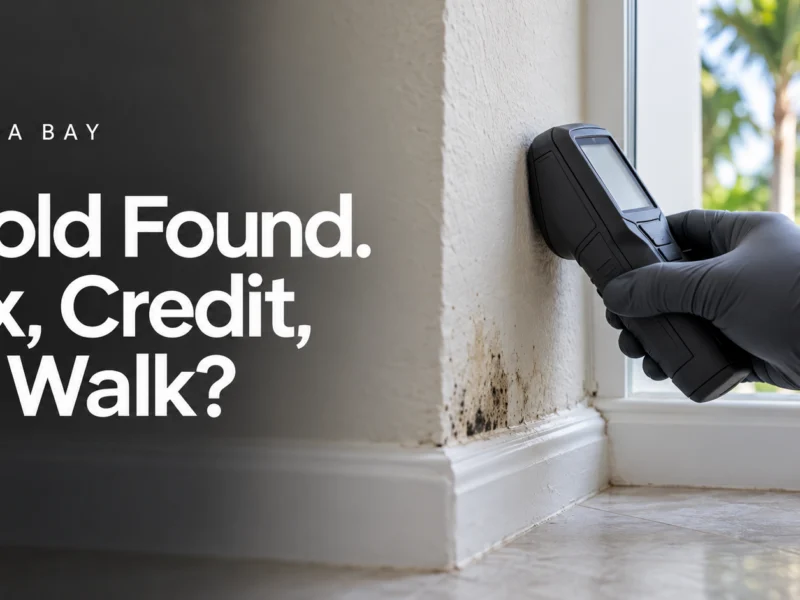
Under the FAR/BAR AS IS contract, a buyer can cancel for any reason before the inspection period ends and get the deposit back. What changes for you is knowledge: defects documented in that buyer’s report now fall under Florida’s Johnson v. Davis disclosure duty. Update your disclosure, decide whether to repair or reprice, and relist with a documented account of what happened.
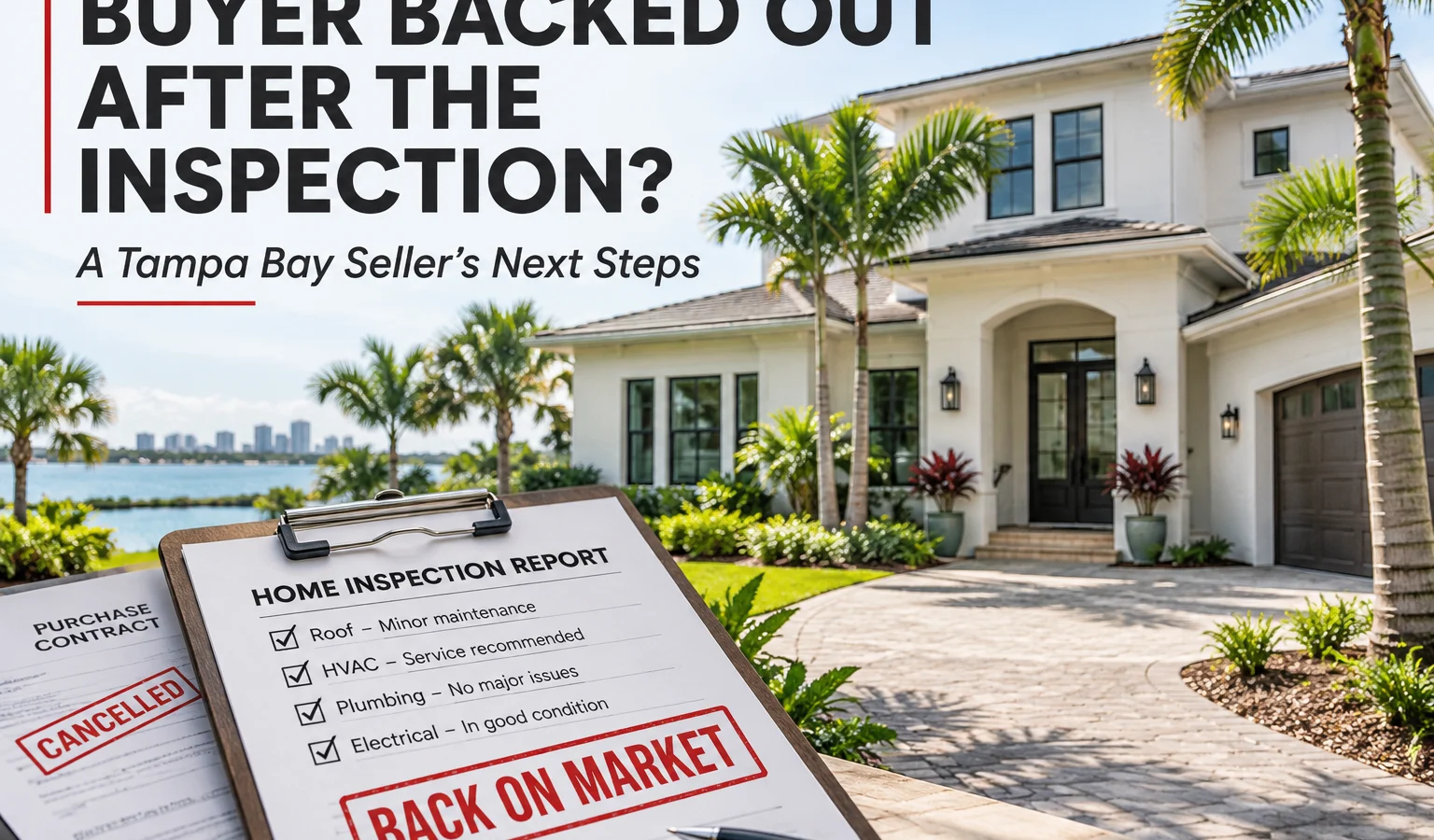
It usually happens on day 10 or 12. The buyer’s agent sends a one-line termination, the title company processes the release, and you’re left holding a 50-page inspection report on a house you thought you had sold. In Tampa, that scene is common: Redfin counted 18.0% of July 2026 purchase contracts in the Tampa metro falling through, among the highest rates of the large U.S. metros it tracks, and 70% of the Redfin agents it surveyed last fall named inspection or repair issues as the reason deals died.
Sellers who write about this on BiggerPockets and r/RealEstate use the same words: the wait is “torture,” the report is “damaging,” and the fear is that it will “kill any sale.” It doesn’t have to. But the next 72 hours are a sequence, not a scramble, and the first step is understanding what the contract just did and what the report just did.
What the AS IS contract gave the buyer, and what it gives you
Nearly every resale in South Tampa, Downtown Tampa, and St. Petersburg is written on the Florida Realtors/Florida Bar AS IS Residential Contract. Paragraph 12 lets the buyer terminate for any reason, in the buyer’s sole discretion, by delivering written notice before the inspection period ends. The form defaults to 15 days; in this market the period is often negotiated to 10. The deposit goes back to the buyer, and the buyer has to repair any damage the inspections caused and return the property to its pre-inspection condition.
Three things follow from that:
- A cancellation inside the window is clean. The buyer owes you nothing beyond restoring the property. If you’re hoping to keep the deposit, read the dates first; a buyer who misses the deadline and then tries to walk is a different conversation, and one I’d have with your attorney. The mechanics are in my post on earnest money and who keeps the deposit.
- You are not automatically entitled to the report. The AS IS form doesn’t require the buyer to hand over inspection reports. (The standard, repair-limit version of the contract does require a copy with the repair notice.) In practice, most buyers’ agents send it, especially if they asked for credits before terminating. Ask for it in writing anyway.
- Your listing goes from Pending back to Active. Stellar MLS keeps a cumulative days-on-market count across linked listings, so the clock your next buyer sees includes the days before the contract and, depending on how the listing was handled, the pending period. Status mechanics are covered in my post on canceled, withdrawn, and expired listings; the short version is that a termination doesn’t reset anything.
Whether you receive the report or only a verbal summary from the buyer’s agent, write down what you were told and when. That record matters for the next section.
The report changed what you know, and that changes what you must disclose
Florida has no checklist statute for residential sellers. The duty comes from Johnson v. Davis, the 1985 Florida Supreme Court case: a seller must disclose known facts that materially affect the value of the property, that aren’t readily observable, and that the buyer doesn’t know. It applies to AS IS contracts, and courts have been consistent about that. I walk through the baseline in what Florida sellers have to disclose before listing.
What a failed inspection does is move items from “unknown” to “known.” Before day 12 you may have had no idea the roof decking was delaminating or that the panel was a recalled brand. After a licensed inspector documents it and you’ve read the report, you know. Florida attorneys who write on this point list “received inspection reports documenting it” as one of the ways a seller acquires actual knowledge, and that knowledge is what the next buyer can sue over if it isn’t disclosed.
So the update is not optional. Here’s the order I use with sellers:
- Revise the Seller’s Property Disclosure. The Florida Realtors SPDR asks what you know about the roof, electrical, plumbing, structure, water intrusion, and more. Change the answers the report changed, date the revision, and have it ready for the next showing. The AS IS contract itself also carries a seller-disclosure clause that restates the Johnson v. Davis standard, so a stale SPDR becomes a contract problem, not just a form problem.
- Disclose facts, not paperwork. You do not have to hand the next buyer the previous buyer’s report. You do have to disclose the material facts in it. “The prior buyer’s inspection on November 3 noted active corrosion on the cast iron drain line under the kitchen” is a disclosure. Forwarding 50 pages with no context is not better, and it isn’t required.
- If the report is wrong, replace it; don’t argue with it. Inspectors miss and inspectors overstate. If the report calls a working pool heater “non-functional,” the fix is a licensed contractor’s written evaluation, dated, that you disclose alongside the original finding. The BiggerPockets seller whose report was “full of errors” did exactly that, made the real repairs, and closed with her next buyer above list.
- Treat insurance findings the same way. In Hyde Park, Palma Ceia, the Old Northeast, and Snell Isle, the deal often dies on the four-point inspection or a carrier’s quote rather than the home inspection: roof age, a Federal Pacific panel, polybutylene supply lines, a water heater past 15 years, or a $10,000 water damage cap on a pre-1986 house. Those are underwriting facts, and once they’re documented they’re disclosable in the same way.
Your listing agent carries a parallel duty under Chapter 475 and the REALTOR® Code of Ethics. If your agent now knows what the report said, your agent has to disclose the material facts too. That’s a reason to coordinate the wording, not a reason to keep anyone in the dark.
Fix, credit, or reprice: three ways the next contract holds
Once the disclosure is right, the decision is economic. Every item in the report lands in one of three buckets, and sorting them is the work.
Fix it when the item is binary. Some findings don’t negotiate; they block. A roof a carrier won’t insure, a panel on a lender’s or insurer’s list, a water heater age that triggers a four-point failure. These will surface on every future buyer’s quote, so a credit only moves the problem to the next inspection period. Fix them, keep the permits and invoices, and order a fresh four-point and wind mitigation report so the next buyer’s agent can send a clean file to the carrier on day two. On a $1.5 million Palma Ceia sale, a $15,000 roof repair that prevents a second failed inspection is cheap; a second failed inspection is what one veteran listing agent who writes on this nationally calls “the kiss of death” for a relist.
Credit it when the item is real but bounded. Worn cabinet hardware, a failing window seal, a pool pump near the end of its life. These belong in a closing cost credit on the next contract, not in a contractor’s schedule before you relist. Credits are faster and cleaner than repairs, with one caution: the buyer’s lender caps seller concessions as a percentage of the price, and a jumbo lender’s cap can differ from a conventional one. Confirm the ceiling with the buyer’s loan officer before you agree to a number.
Reprice when you won’t fix and the item is expensive. Cast iron drain lines under a 1950s slab, a failing seawall, foundation movement, a roof you’ve decided not to replace. Here the honest path is to price for condition, disclose fully, and expect a buyer pool weighted toward cash and renovation-minded purchasers. My post on cast iron pipes in a South Tampa home shows the buyer’s side of that math. Pretending the item is a credit-sized problem produces a third termination.
The number that anchors all three is what the house is worth with the defect known. In the 33629 ZIP alone, 190 of 579 listings that ended between October 2025 and October 2026 ended without a sale. Many of those were priced for a condition the market never agreed with. A relist is a repricing decision whether or not you change the number, and it should start from current closings rather than from the contract price you just lost.
Going back to Active without the stigma
A back-on-market listing draws a specific phone call: the next buyer’s agent asks your agent what happened. The sellers who relist well have the answer ready before the status changes.
- One factual sentence, then the documents. “The buyer terminated during the inspection period over the roof; it was replaced on November 20 under permit, and the new four-point and wind mit are attached.” No opinions about the buyer, no speculation about cold feet. Attach the revised SPDR, invoices, permits, and new insurance reports to the MLS listing so the file answers the question before it’s asked.
- Decide the price with fresh comps, not the old contract. If the first contract came in after multiple offers, the price may hold. If it was the only offer in 45 days and the buyer walked, the market has now told you twice. Trimming on the relist usually beats trimming after another 30 days of showings; my post on whether to lower the price on a South Tampa home covers how to read that.
- Call the backup offers first. If you collected backup offers while pending, those buyers already liked the house at a number. Disclose the findings, present the fix or the credit, and you may be under contract again before the listing hits a feed.
- Tighten the next inspection period. Counter at 7 to 10 days rather than 15, and ask that the buyer’s insurance quote be in hand by day 5. In older South Tampa and St. Petersburg housing stock the insurance quote is the inspection that matters, and a buyer who hasn’t started it by midweek is a buyer who may walk on the last day.
- Move in days, not weeks. Showings that were scheduled before the termination still want to happen. A listing that sits in a limbo status while you decide reads worse than one that goes back to Active with a clear story and a fixed roof.
A termination over a repairable item, handled this way, often closes with the next buyer at or near the original number. A termination that goes unaddressed, with an outdated disclosure and the same price, is how a house ends up in the canceled-and-expired column that makes up a third of ended South Tampa listings.
Frequently Asked Questions
Does a Florida seller have to give the next buyer the previous buyer’s inspection report?
No. You’re not required to hand over the report itself, and the AS IS contract doesn’t obligate the prior buyer to give it to you. You are required to disclose the material facts you learned from it that affect value and aren’t readily observable, under Johnson v. Davis. Update the Seller’s Property Disclosure with those facts; the report is evidence of what you know, not the disclosure.
Can I keep the deposit if the buyer cancels after the inspection in Florida?
Not if the buyer delivered written notice before the inspection period ended. Under the FAR/BAR AS IS contract, a timely termination returns the deposit in full. If the buyer missed the deadline and then tried to cancel, you may have a claim, which runs through the contract’s escrow-dispute and mediation steps; talk to a Florida real estate attorney before you refuse a release.
Does my days-on-market count reset when the house comes back on the market?
Generally no. Stellar MLS carries a cumulative days-on-market figure across linked listings for the same property, so a termination and return to Active doesn’t start you over. A buyer’s agent can see the pending period and the prior listing history. Treat the number as a fact to explain rather than one to hide; a documented fix and a price supported by current closings carry more weight than a low day count.
Should I get my own inspection before relisting after a failed one?
In most cases, yes, but as a targeted evaluation rather than a second general inspection. Hire a licensed roofer, electrician, or plumber to evaluate the specific items the buyer’s inspector flagged, get the findings in writing, and either repair or disclose. If the deal died on insurance, order a fresh four-point and wind mitigation report after repairs. Remember that anything a new inspection finds becomes something you now know and must disclose.
Do I have to tell the next buyer why the first buyer walked?
You have to disclose the material facts, not the buyer’s reasons. If the buyer left over a documented roof defect, that defect is disclosable. If the buyer left over financing, a job change, or cold feet, those are the buyer’s circumstances and not facts about the property. Keep the explanation to what the report found and what you did about it.
The decision that actually matters
A buyer walking during the inspection period is a setback, not a verdict on the house. What decides the next 30 days is whether the disclosure is current, whether the binary items are fixed, and whether the price reflects what the market now knows.
If you’re weighing a relist after a terminated contract, start with a current valuation of your home — not an algorithm’s guess, and not the number on the contract that fell through, but a figure grounded in what’s actually closing in your neighborhood and building. Request yours at shanevanderson.com/evaluation, or call 813-205-5430.
This article is general information for Tampa Bay buyers and sellers, not insurance or legal advice. Policy terms, carrier underwriting rules, and court rulings change; confirm coverage questions with a licensed Florida insurance agent and contract questions with a Florida real estate attorney.
About Shane Vanderson
Shane Vanderson is a Broker Associate and License Partner with Engel & Völkers South Tampa, licensed in Florida since 2012 and specializing in luxury and waterfront residential real estate, condos, and new construction across Tampa Bay. He advises buyers and sellers across South Tampa, Downtown Tampa, St. Petersburg, and the beaches, and is part of the Engel & Völkers Professional Athlete Advisory program. Reach him at 813-205-5430 or shane.vanderson@engelvoelkers.com.