What can a buyer do if the final walk-through on a Tampa Bay home turns up a problem?
Quick answer
Under the FAR/BAR AS IS contract, the seller must deliver the home in its effective-date condition, with personal items and trash removed and every contracted item in place. If the walk-through shows otherwise, the buyer can ask for a credit, an escrow holdback, or a short written extension. The contract gives no right to cancel over cosmetic issues.
A national analysis of MLS pending-sales data put Tampa’s contract-cancellation share at 18.0% in July 2026, against a national 14% that was the highest in nearly three years. Most of those deals die in the inspection period or the loan approval period. A smaller number die in the last 24 hours, at the walk-through, over a problem that should have cost a few hundred dollars to settle.
The walk-through is not a second inspection, and it is not a second chance to renegotiate price. It has one job under the contract. Buyers who know what that job is can protect themselves without blowing up the closing, and sellers who know what the contract requires of them in the final week can avoid handing a buyer leverage on closing day.
Here is what the Florida Realtors/Florida Bar AS IS contract requires, the problems that actually show up in South Tampa, Downtown Tampa, and St. Petersburg closings, and the four tools for resolving them, from least to most disruptive. (The post on what happens after you accept an offer covers the full contract timeline; this one covers the last day of it.)
What the FAR/BAR AS IS contract requires at the walk-through
Four paragraphs do the work. Paragraph numbers below follow the current Florida Realtors/Florida Bar AS IS Residential Contract; confirm against your own copy, since the form is revised periodically.
- Paragraph 11, Property Maintenance. Except for ordinary wear and tear and casualty loss, the seller must maintain the property, “including, but not limited to, lawn, shrubbery, and pool,” in the condition existing as of the effective date. The contract calls this the AS IS Maintenance Requirement. The benchmark is the day the contract was signed, not the day of the inspection and not the listing photos.
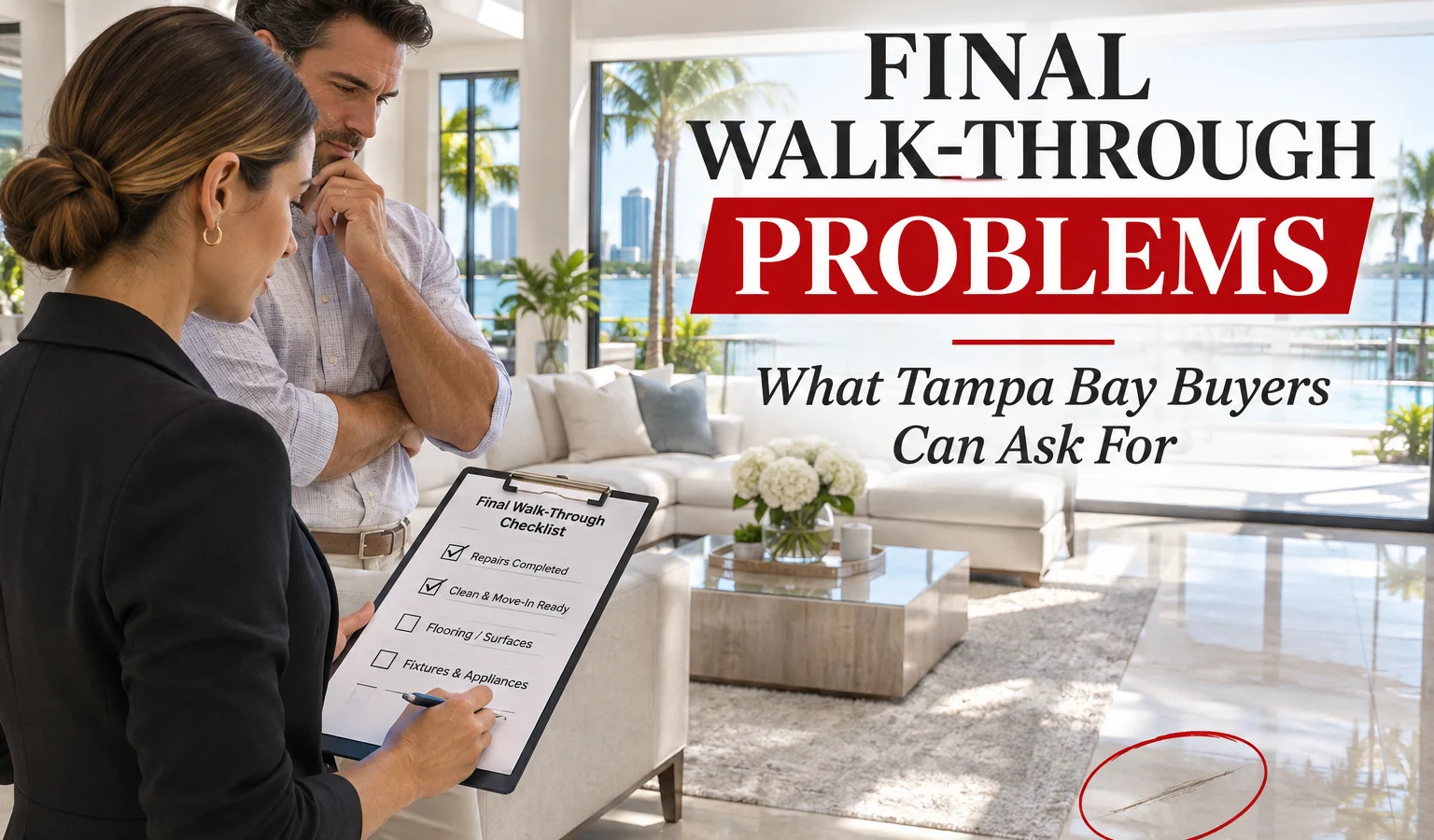
- Paragraph 12(b), Walk-Through Inspection. On the day before closing, or on closing day before the time of closing, the buyer or the buyer’s representative may walk the property “solely” to confirm that all items of personal property are on the property, that the seller has met the maintenance requirement, and that the seller has met all other contractual obligations. A follow-up walk-through is allowed if the first one finds a problem.
- Paragraph 6, Occupancy and Possession. The seller delivers occupancy at closing, removes all personal items and trash, and hands over keys, garage door openers, access devices, and codes.
- Paragraph 1, Personal Property. Existing appliances, built-in furnishings, light fixtures, ceiling fans, window treatments and hardware, and similar attached items convey unless they are listed as excluded. Anything else the seller agreed to leave has to be written into the contract to be enforceable at the walk-through.
Two things the contract does not say. It does not use the phrase “broom clean”; the standard is personal items and trash removed, which is a lower bar than many buyers expect and a higher one than some sellers deliver. And it does not give the buyer a general right to cancel at the walk-through. The inspection-period cancellation right in Paragraph 12(a) expired weeks earlier. What the buyer has at the walk-through is a claim that the seller has not performed, and the remedies that follow from that.
The problems that actually show up in Tampa Bay closings
National checklists cover burnt-out bulbs and missing remotes. These are the issues that cost real money here, in roughly the order I see them.
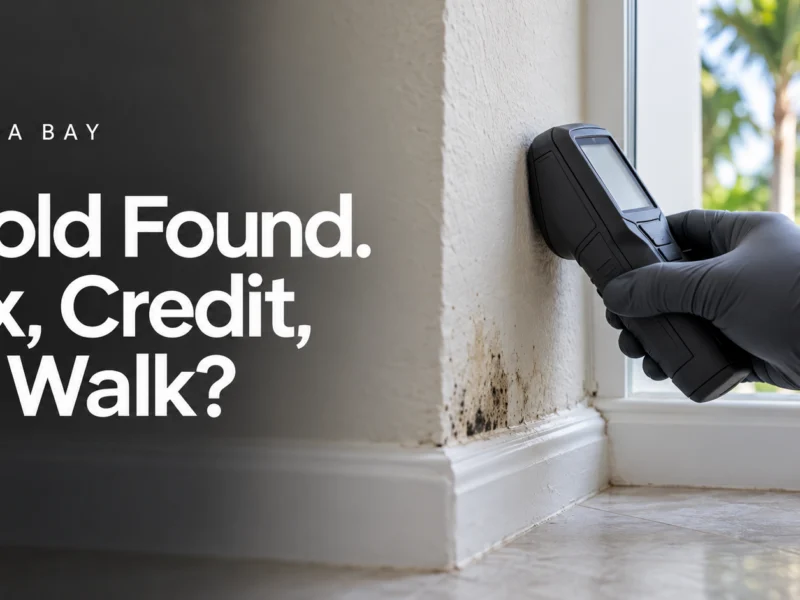
The air conditioning was turned off in a vacant home. A seller who moved out in October and shut the system down to save a utility bill can hand over a house with condensation on the windows, a musty smell, and the beginnings of mold growth in closets within two or three weeks of Florida humidity. A Villages forum poster described walking into a closing-day house where the thermostat read 78 and nothing changed when she dropped it to 74; another member’s reply was the right one for every vacant Florida home: keep the AC running when the house is unoccupied because of humidity. Mold that was not there on the effective date is a Paragraph 11 problem, and it is the one most likely to require a delay rather than a credit.
The pool went green or the lawn went brown. Paragraph 11 names the lawn, shrubbery, and pool specifically. A seller who cancels the pool service the week of the move is in breach the moment the water clouds. On a Bayshore Beautiful or Snell Isle home with a heated pool and spa, a restart service and chemical balance is a few hundred dollars; a pump that was run dry is not.
Something attached is gone. The dining room chandelier, the mounted TVs in the lanai, the smart-home hub and its hub-controlled shades, the outdoor kitchen’s refrigerator, the generator transfer switch, the propane tank, the boat lift remote. Under Paragraph 1, attached items and the listed appliances convey unless excluded in writing. TV mounts convey; the televisions on them do not unless the contract says so. The furnished-home post covers how to list inclusions and exclusions so this never becomes a closing-day argument.
The movers damaged something. Deep scratches in a wood floor from a dragged safe, a gouged elevator-lobby wall in a Harbour Island or Downtown St. Pete tower, a cracked paver from the moving truck. A BiggerPockets buyer found two 22-inch scratches in a beveled hardwood entry after closing, with a repair quote near $1,400, and the thread’s consensus was blunt: “This is the reason that we do the final walk through immediately before closing.” Damage found before closing is the seller’s to fix or credit under Paragraph 11. Damage found after closing is a much harder claim.
Agreed repairs were not finished, or were finished without paperwork. If the inspection period ended with a signed repair agreement, the walk-through is where the buyer confirms the work and collects the receipts and permits. Work done by an unlicensed handyman, or a roof repair with no permit where Hillsborough or Pinellas required one, is an open item at closing. Open permits are their own problem; the open-permits post covers how they surface in the lien search and who pays to close them.
Things were left behind, or the utilities were already off. Stager furniture that was supposed to be out Tuesday, a garage full of paint cans, patio furniture the seller “thought you’d want,” and a house with the water off so the buyer cannot run a single faucet. All of these are Paragraph 6 issues and all of them are fixable the same day if the seller is reachable.
The four ways to resolve a walk-through problem, from least to most disruptive
The right tool depends on two things: whether the problem can be priced, and whether the buyer’s lender will allow the fix. On a cash deal, which describes a large share of closings above $2 million in South Tampa, the parties can agree to almost anything in writing. On a financed deal, the lender gets a vote.
1. A credit on the closing statement
The cleanest fix for anything with a known cost: the pool restart, the carpet cleaning, the missing fixture, the junk removal. The seller’s side of the closing statement shows a credit to the buyer, the buyer handles the repair after closing, and the closing proceeds on time.
Two cautions on financed deals. A seller credit counts against the lender’s cap on seller concessions, and a buyer who already negotiated a credit toward closing costs may have no room left. And a late change to the price or credit has to go back through the lender; depending on what it changes on the Closing Disclosure, it can re-trigger the three-business-day waiting period before closing. Ask the loan officer before agreeing to the number, not after.
2. An escrow holdback
When the problem is real but the repair cannot be completed before closing, the parties can close on schedule and leave part of the seller’s proceeds with the title agent until the work is done. The contract contains no holdback mechanism outside of casualty loss, so a holdback is a separate written escrow agreement: the amount, who performs the work, the deadline, who inspects, and where any leftover funds go.
Holdbacks are sized above the repair estimate to cover overruns. Rocket Mortgage’s October 2026 guidance puts the usual lender requirement at 110% to 200% of the estimate, with conventional loans typically at 120% and VA loans at 150%, and completion windows of about 180 days. Lenders generally approve holdbacks for minor or weather-delayed work and refuse them for anything touching safety, structure, or habitability; those repairs have to be done and inspected before funding. A title company officer quoted in a national walk-through guide this spring added the practical warning: lenders often restrict repair escrows late in the process, so a holdback discovered on closing morning is harder to arrange than one set up three days earlier.
On a cash deal, the holdback is simply a negotiation between buyer and seller, and the seller customarily selects the title agent in Hillsborough and Pinellas, so that agent is usually the one holding the funds.
3. A short written extension
Some problems need a contractor on site before anyone can price them: active mold in a closet, a wet ceiling under a bathroom, an AC system that will not cool. Delaying closing by a few days to get an estimate is reasonable, but it has to be in writing. Time is of the essence under Standard F, and a closing date that passes without a signed extension puts one party in default.
Delay has a cost on the buyer’s side, too. A rate lock that expires during the extension is extended at the buyer’s expense, often a fraction of a point, and a lender that waives a short extension may not waive a second one. A buyer who asks for time should expect the seller to ask what the time is for and when it ends.
4. Refusing to close
This is the remedy buyers reach for first and should use last. If the seller has not performed, Paragraph 15 gives the buyer a choice: take the deposit back, or pursue specific performance or damages. An attorney quoted in the same guide put it plainly: if the seller refuses a credit or an escrow, “the buyer can refuse to close until the issue is resolved.” That is true when the seller’s failure is material. It is not true for a dirty oven or a missing patio umbrella, and a buyer who refuses to close over a cosmetic item has become the party in default, with the deposit at risk under Paragraph 15 and the prevailing party’s attorney’s fees under Paragraph 17 on the line.
The test is whether a judge would see the seller’s failure as a breach of Paragraph 6, 11, or 1 that the buyer could not reasonably be expected to absorb with a credit. Mold, a dead HVAC system, a stripped kitchen, or a house still full of the seller’s belongings can meet it. Most walk-through complaints do not.
What sellers should do in the last week
Every item in the section above is a seller’s problem to prevent, and most prevention is cheap.
- Keep the AC on and set between about 76 and 78 degrees after you move out, with a dehumidify setting if the system has one. Do not shut the water off; the buyer needs to run it.
- Keep the pool and lawn service through closing day, not through your move-out day.
- Do not swap fixtures, fans, or appliances after the effective date. If you want to keep the dining room chandelier, it should have been excluded in the contract; if it was not, it conveys.
- Finish agreed repairs at least a few days before the walk-through, use licensed contractors, and put receipts, permit close-outs, and any warranties in a folder for the buyer.
- Photograph every room after the movers leave and before the buyer walks through. If the condition is disputed later, you want dated pictures.
- In a condo tower, reserve the elevator and loading dock for your move-out well in advance, and leave time for the building to inspect the common areas for move damage before closing.
- Leave keys, fobs, garage and gate openers, alarm and smart-lock codes, and the manuals in one place, and tell your agent where it is.
Sellers who need to stay a few days past closing should not improvise it on closing morning; the rent-back post covers how Rider U and a post-closing occupancy agreement handle that.
Storm damage after contract is a different paragraph
If the walk-through finds damage from a storm or fire rather than from the seller’s neglect, Paragraph 11’s carve-out for casualty loss applies and Standard M takes over. If restoring the property costs 1.5% of the purchase price or less, the seller pays for it; if the work is not finished by closing, the seller escrows 125% of the remaining estimate. If the cost exceeds 1.5%, the buyer can take the property with a 1.5% credit or cancel and recover the deposit. The hurricane-season closing post covers those mechanics in detail.
Timing: the day before, or the day of?
Paragraph 12(b) allows either. For an occupied home, I prefer the morning of closing, after the movers have left, with a backup plan to walk again if something turns up. For a vacant home, the day before works and leaves time to fix what is found. In either case, the buyer’s agent should be in the house with the buyer, running every faucet and appliance, opening every closet, and checking the thermostat against what the inspection report recorded. The point of the walk-through is to find problems while the seller still has an incentive to solve them.
Frequently Asked Questions
Can a buyer back out after the final walk-through in Florida?
Not over cosmetic or minor issues. The FAR/BAR AS IS inspection-period cancellation right ends weeks before closing. At the walk-through the buyer can only hold the seller to the contract: items that convey must be present, the home must be in its effective-date condition, and personal items and trash must be gone. If the seller materially fails those obligations and refuses a credit, holdback, or extension, the buyer can treat it as a seller default under Paragraph 15 and recover the deposit, but refusing to close over a small item puts the buyer in default instead.
Does a Florida seller have to leave the house clean?
The FAR/BAR AS IS contract does not say “broom clean.” Paragraph 6 requires the seller to remove all personal items and trash and deliver keys, openers, access devices, and codes at closing, and Paragraph 11 requires the home to be in the condition it was in on the effective date, ordinary wear and tear excepted. Anything stricter, such as professional cleaning, has to be written into the contract.
What happens if the seller’s movers damage the floors before closing?
Damage that occurs after the effective date is the seller’s responsibility under Paragraph 11. If the walk-through finds it, the buyer can ask for a credit for the repair, an escrow holdback if the repair cannot be done before closing, or a short written extension. If the damage is found only after closing, the buyer’s recourse is much weaker, which is why the walk-through belongs as close to closing as possible.
How does an escrow holdback work at a Tampa Bay closing?
The parties sign a separate written escrow agreement, and the title agent keeps part of the seller’s proceeds until the agreed work is finished and verified. Holdbacks are usually sized above the estimate, often 120% to 150%, with a deadline of up to 180 days. On a financed purchase the lender must approve the holdback, and lenders generally refuse holdbacks for repairs involving safety, structure, or habitability.
Should the walk-through be the day before closing or the day of?
Paragraph 12(b) of the FAR/BAR AS IS contract allows either, and a follow-up walk-through if needed. For an occupied home, the morning of closing after the movers have left catches move-out damage. For a vacant home, the day before leaves time to fix what is found. Either way, utilities should be on so the buyer can run water, appliances, and the air conditioning.
A walk-through problem is almost never a reason to lose a sale. It is a pricing question with a contract behind it: what the seller owed on the effective date, what is missing or damaged now, and which of the four tools closes the gap without pushing the closing date. Buyers who walk the house carefully and sellers who keep it running through closing day rarely need more than a line on the closing statement.
If you’re weighing a sale, start with a current valuation of your home — not an algorithm’s guess, but a number grounded in what’s actually closing in your neighborhood and building. Request yours at shanevanderson.com/evaluation, or call 813-205-5430.
This article is general information for Tampa Bay buyers and sellers, not insurance or legal advice. Policy terms, carrier underwriting rules, and court rulings change; confirm coverage questions with a licensed Florida insurance agent and contract questions with a Florida real estate attorney.
About Shane Vanderson
Shane Vanderson is a Broker Associate and License Partner with Engel & Völkers South Tampa, licensed in Florida since 2012 and specializing in luxury and waterfront residential real estate, condos, and new construction across Tampa Bay. He advises buyers and sellers across South Tampa, Downtown Tampa, St. Petersburg, and the beaches, and is part of the Engel & Völkers Professional Athlete Advisory program. Reach him at 813-205-5430 or shane.vanderson@engelvoelkers.com.