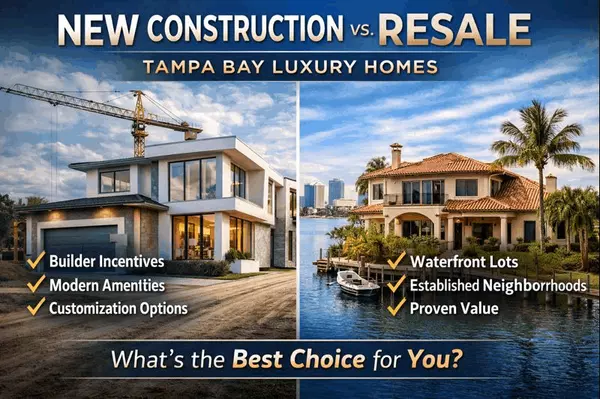
New Construction vs. Resale in Tampa Bay Luxury: How to Choose Between Builder Incentives, Waterfront Lots, and Established Neighborhoods
Should you buy new construction or a resale luxury home in Tampa Bay—and how do you weigh builder incentives against waterfront lots and established neighborhoods?
Buy new construction if you value warranty, modern systems, and incentives; choose resale if you want mature neighborhoods, true waterfront lots, and proven livability. Decide by comparing total cost, timeline, and location scarcity.
Introduction
If you’re shopping Tampa Bay luxury right now, you’re probably seeing two very different “value stories.” On one side: new construction with glossy design centers, rate buydowns, and closing-cost credits. On the other: resale homes in established enclaves—often closer to the water, with mature trees, bigger lots, and a neighborhood feel you can’t replicate quickly.
Here’s the real issue: in luxury, the “best deal” isn’t the lowest price—it’s the smartest match for your lifestyle, timeline, and long-term resale strength. Builder incentives can be real money, but so is a rare waterfront lot on a street where nothing ever comes up for sale. And Tampa Bay isn’t one market; South Tampa, Westchase, Downtown St. Pete, and newer master-planned areas each behave differently.
This guide helps you make a decision like an owner—not a shopper—so you can choose confidently between new construction vs. resale in Tampa Bay luxury.
1) Start With What’s Scarce: Location, Lot, and Lifestyle Fit (Not the House Itself)
In Tampa Bay luxury, the most important factor is usually what cannot be easily replaced. Floorplans, finishes, appliances, and even square footage can be changed or rebuilt over time. But the “bones” of value—location and land—are far harder to replicate, especially near the water.
If you’re deciding between builder incentives and an established resale, ask yourself: What are you actually buying? With resale, you’re often buying a position—a street, school boundary preference, commute pattern, or waterfront orientation that isn’t being created again. With new construction, you’re usually buying certainty—new systems, modern design, and fewer surprises.
Consider these scarcity questions:
- Waterfront reality: Is it true open-water frontage, canal access with fixed bridges, or simply “water view”? Resale listings often have more varied and genuinely scarce waterfront positions because they were built when land was less constrained.
- Lot characteristics: Corner lots, deeper lots, better elevation, and more usable backyard space can matter as much as interior upgrades.
- Neighborhood maturity: Established neighborhoods offer tree canopy, a consistent streetscape, and proven livability (noise, traffic patterns, community norms).
- Commute and daily life: The difference between a 12-minute and 35-minute drive compounds quickly—especially if you travel frequently or need quick access to dining, airports, or business centers.
Actionable way to decide: write down your three non-negotiables (for example: “no bridge restrictions,” “easy access to dining,” “preferred school boundary,” “boat lift potential,” “no HOA,” “gated,” “quiet cul-de-sac”). Then score each property against them. If a resale nails all three and a new build nails only one, incentives won’t fix that mismatch.
Luxury rule of thumb: If your priority is scarce land (waterfront, historic enclave, established South Tampa or St. Pete streets), resale often wins. If your priority is predictability and modern performance, new construction rises to the top.
2) Builder Incentives vs. Resale Negotiation: Compare “Net Cost,” Not Sticker Price
Builder incentives can be meaningful, but you need to evaluate them the same way you would evaluate a portfolio: what’s the net benefit, what’s the risk, and what are the strings attached?
Common incentives you may see in Tampa Bay luxury new construction:
- Closing cost credits
- Temporary or permanent rate buydowns (often tied to preferred lenders)
- Design center credits (upgrades to cabinets, flooring, appliance packages)
- Lot premium reductions (especially if inventory has lingered)
- HOA/amenity credits in certain communities
The key is to translate every incentive into a clean “net” number and compare that to the resale alternative. A design credit feels valuable, but if it only nudges you toward upgrades you wouldn’t otherwise choose, it’s not true savings.
When you compare new construction vs. resale, use this framework:
A. True net cost (New Construction)
- Base price + lot premium + structural options
- + upgrades you actually want (not the showroom “must-haves”)
- + HOA/CDD (if applicable) and any community fees
- – verified incentives (closing, rate buydown, credits)
- + carrying costs during build (rent, storage, travel, time cost)
B. True net cost (Resale)
- Purchase price
- + immediate improvements (paint, roof timeline, HVAC age, pool refresh)
- + insurance considerations (especially near water; wind/flood requirements vary)
- – negotiated concessions (repairs, credits, price reductions)
- + opportunity cost (time spent renovating vs. moving in)
Important nuance: resale negotiations often show up as inspection-driven concessions and price adjustments—less flashy than builder incentives but potentially just as powerful. New construction can reduce surprise repairs, but it can also come with change orders and “upgrade creep” if you’re not disciplined.
Actionable move: ask for a one-page comparison showing:
- Total cash to close
- Estimated monthly payment (same down payment assumptions)
- HOA/fees
- Insurance estimate ranges
- 12-month “all-in” cost projection
If a builder requires using a preferred lender to unlock incentives, evaluate it like any other offer: you’re not judging the incentive; you’re judging the package. You can also compare lender offers independently to ensure you’re not giving back savings through rate/fees.
3) Waterfront Lots: Why Resale Often Wins (But New Builds Can Still Make Sense)
Waterfront changes the math because land scarcity and risk management matter more than finishes. Many of Tampa Bay’s most desirable waterfront pockets are already built out. That means resale is often where true waterfront inventory lives—especially if you want a specific canal, bay access, or a proven boating lifestyle.
If you’re waterfront-focused, your decision should hinge on three categories:
A) Access and usability
You’re not just buying “waterfront.” You’re buying boating practicality:
- Fixed bridges and clearance restrictions
- Distance to open water and no-wake zones
- Canal width and turning radius for your boat
- Lift suitability and seawall condition
- Exposure: protected canal vs. open bay conditions
A resale home may come with an existing lift, dock, and seawall history you can inspect. That “known quantity” is valuable.
B) Insurance and resilience reality
Waterfront can bring higher insurance complexity. New construction can sometimes help with:
- Modern wind mitigation features
- Newer roofs and impact-rated openings
- Updated elevation and drainage planning (varies by site)
But don’t assume “new” automatically means “low cost.” A waterfront new build on a premium lot may still carry substantial insurance requirements. The smarter approach is to shop the property’s risk profile early—before you’re emotionally committed.
C) Timeline and permitting
If you’re considering building waterfront (or buying a teardown-to-build scenario), factor in:
- Permitting timelines and inspections
- Specialized coastal requirements
- Seawall permitting/repair complexities
- Material lead times and contractor scheduling
For many luxury buyers, resale waterfront is the quickest path to living the lifestyle now—especially if the boating season matters to you.
When can new construction win on/near waterfront?
- You find a rare buildable lot with the orientation you want
- You need modern construction standards and prefer a clean-slate design
- You’re willing to trade timeline for customization and long-term system efficiency
Decision tip: if your “must-have” is a specific waterfront experience (quick bay access, lift-ready, deeper water), resale often offers more certainty. If your “must-have” is a custom waterfront home that fits your exact spec, building may be worth the wait—if you budget time and contingency correctly.
4) Established Neighborhoods vs. New Communities: The Luxury “Feel” and Resale Strength
A major separator between new construction vs. resale in Tampa Bay luxury is whether you want an established neighborhood or a newer community ecosystem.
Why established neighborhoods can feel more “luxury” in daily life
Luxury isn’t only the home—it’s the environment around it:
- Mature landscaping and tree canopy
- Streets that feel cohesive (less construction noise and dust)
- Proven traffic patterns and neighborhood rhythm
- Character architecture and lot variety
- Closer-in positioning for dining, arts, and waterfront parks
Resale often gives you that “already arrived” feeling. You can also evaluate neighbors, parking patterns, weekend noise, and how the area behaves during peak events.
Why newer communities can be the right luxury choice
Newer construction hubs and master-planned areas often deliver:
- Amenities (clubhouses, fitness, tennis/pickleball, trails)
- Newer infrastructure and consistent streetscapes
- Gated options and clearer community rules
- Larger interior square footage for the price (in some submarkets)
- Lower immediate maintenance on major systems
If your lifestyle is centered around “home as a resort,” a newer luxury community can be a strong match.
Actionable neighborhood test (do this before you decide):
- Visit the area weekday 7–9am (commute reality).
- Visit Friday 6–9pm (noise, dining traffic, social vibe).
- Drive the route to your top 3 recurring destinations (airport, office, marina, gym).
- For resale: walk the street and note roof ages, parked cars, and upkeep consistency.
- For new builds: ask how many nearby lots are still under construction and for how long.
Resale strength often follows “proven desire.” Established luxury streets with limited turnover can be resilient because supply is naturally constrained. New construction resale strength depends heavily on:
- How many similar homes will compete with you later
- Whether your upgrades match buyer expectations
- Whether your lot is meaningfully better than the average lot in the community
If you buy new construction, prioritize lot quality and layout over trendy finishes. Finishes date faster than a great lot.
FAQ
1) Are builder incentives in Tampa Bay luxury homes really worth it?
They can be—if they reduce your true net cost (cash to close, interest rate, or unavoidable upgrades). They’re less valuable if they push you into a preferred lender with higher fees or into upgrades you wouldn’t choose.
2) Is resale always better for waterfront in Tampa Bay?
Not always, but resale often offers more established waterfront options because many premium lots are already built out. New builds can win when you find a rare buildable waterfront lot or you’re doing a custom project and can manage time, permitting, and contingency.
3) What’s the biggest “hidden cost” difference between new construction and resale?
For new construction, it’s often upgrade creep, timeline carrying costs, and community fees (HOA/CDD where applicable). For resale, it’s usually system age (roof/HVAC), insurance complexity near water, and the cost or disruption of renovations after closing.
Closing
Choosing between new construction vs. resale in Tampa Bay luxury comes down to one question: Do you value certainty and modern performance more than irreplaceable location and neighborhood maturity? Builder incentives can improve your numbers, but they shouldn’t override fundamentals like waterfront access, lot quality, and day-to-day livability.
If you want to make the decision cleanly, your next step is to compare two or three finalist homes using the same “net cost + lifestyle fit” scorecard—then validate waterfront/access (if relevant), insurance ranges, and your realistic timeline before you commit. If you’d like, share your top priorities (waterfront vs. not, timeline, preferred areas, and budget range), and I can help you build a side-by-side decision matrix you can actually use.
Categories
- All Blogs (135)
- 345 Bayshore (3)
- 400 Central (2)
- Apollo Beach (23)
- Arbor Greene (6)
- Avila (38)
- Ballast Point (6)
- Bayshore Beautiful (6)
- Beach Park (34)
- Bel Mar Gardens (4)
- Belleair Beach (5)
- Brandon (10)
- Carrollwood (31)
- Channel District (12)
- Cheval (20)
- Clearwater (34)
- Clearwater Beach (14)
- Cordoba Ranch (5)
- Cory Lake Isles (4)
- Culbreath Isles (23)
- Davis Islands (43)
- Downtown St Petersburg (15)
- Downtown Tampa (45)
- Golfview (18)
- Grand Central at Kennedy (1)
- Gulf Beaches (5)
- Harbour Island (46)
- Home Buying (9)
- Home Improvement (1)
- Home Selling (22)
- Hunters Green (14)
- Hyde Park (37)
- Indian Rocks Beach (8)
- Ladera (7)
- Lakewood Ranch (9)
- lutz (38)
- Luxury Homes (6)
- Madeira Beach (22)
- Marina Pointe (23)
- Market Health Update (20)
- New Suburb Beautiful (3)
- New Tampa (10)
- Odessa (29)
- Old Northeast (2)
- ONE St. Petersburg (1)
- ONE Tampa (3)
- Palma Ceia (7)
- Parkland Estates (4)
- Pendry Tampa (7)
- Pinellas Condos (7)
- Plaza Harbour Island (4)
- Reviews (2)
- Ritz-Carlton Tampa (11)
- Riverview (26)
- Safety Harbor (3)
- Saltaire (1)
- Seminole Heights (25)
- Skypoint (5)
- Snell Isle (20)
- South Tampa (75)
- St Pete Beach (27)
- St Petersburg (48)
- Sunset Park (30)
- Tampa (75)
- Tampa Bay New Construction (2)
- Tampa Bay Real Estate (40)
- Tampa Bay Waterfront (3)
- Tampa Condos (12)
- Tampa Edition (9)
- Tampa Palms (20)
- The Nolen (3)
- The Place Channelside (1)
- Tierra Verde (20)
- Towers of Channelside (2)
- Treasure Island (4)
- Venetian Isles (21)
- Viceroy Clearwater Beach (2)
- Virginia Park (12)
- Waldorf Astoria St Petersburg (4)
- Water Street (21)
- Waterleaf (4)
- Westchase (33)
- Westshore Marina District (26)
- Westshore Yacht Club (6)
- Ybor (8)
Recent Posts