New Development Projects vs. Established Homes in Tampa Bay: Should You Buy NOW in 2026?
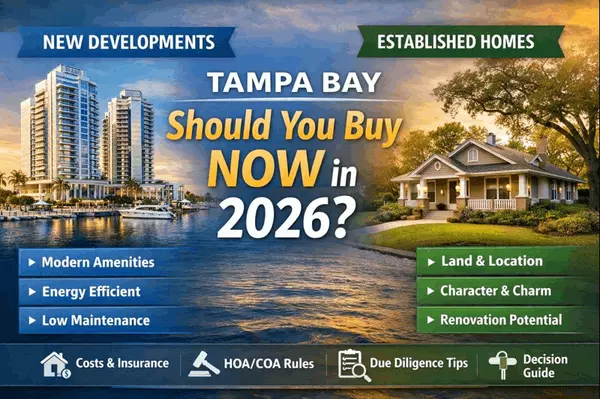
Should you buy now in 2026—and should it be a new development project or an established home in Tampa Bay?
Buy now in 2026 if you’ve found a property that fits your lifestyle and your insurance/flood-risk tolerance. Choose new builds for warranties, efficiency, and amenities; choose established homes for mature neighborhoods, lot value, and renovation upside.
Introduction
If you’re a high-net-worth buyer considering Tampa Bay in 2026, you’re not just choosing a home—you’re choosing a risk profile. The difference between a brand-new condo or master-planned community home versus an established property in South Tampa, St. Petersburg, Clearwater, or along the Gulf can show up in your monthly carry costs, your insurance options, your ability to rent or resell, and your day-to-day quality of life.
The challenge is that “new” doesn’t always mean “lower risk,” and “established” doesn’t always mean “better value.” In Tampa Bay, the smartest decision in 2026 usually comes down to three variables you can control: (1) how you plan to use the property (primary, second home, or investment), (2) which costs you’re optimizing for (time, privacy, convenience, or total cost of ownership), and (3) your tolerance for construction timelines, HOA governance, and climate-related underwriting.
This guide breaks down the tradeoffs clearly—so you can decide whether to buy now, what to buy, and what to verify before you commit.
Main Content
1) The 2026 “Buy Now” Question: Timing, Leverage, and What You Can Actually Negotiate
In 2026, the key question isn’t “Will prices go up?” It’s “Can you secure a property that meets your non-negotiables at a carry cost you’re comfortable with—and can you negotiate terms that reduce your downside?” For affluent buyers, timing is often less about squeezing the last dollar and more about controlling exposure: insurance volatility, HOA special assessments, interest-rate sensitivity (if you finance), and the opportunity cost of waiting.
When buying now makes sense (even if you think the market may soften later):
- You’re relocating on a fixed timeline (business move, family needs, school year).
- You’ve identified a rare match (specific view corridor, lot size, dock rights, walkability).
- You want to lock in a lifestyle asset rather than “trade” the market.
- You can negotiate credits or concessions that improve your effective price.
What you can often negotiate more effectively in 2026 (especially in new development):
- Closing cost credits or interest-rate buydowns (if financing).
- Upgrade packages (appliances, flooring, smart-home, parking/storage units).
- Extended builder warranties or punch-list protections.
- Longer due diligence periods, especially if you’re coordinating a sale elsewhere.
For established homes, your leverage typically shows up differently:
- Inspection repairs and roof/HVAC concessions.
- Appraisal-gap strategy (either avoiding it, or using it selectively for rare properties).
- Price reductions tied to days on market, dated interiors, or insurance-related friction.
- Post-occupancy agreements (useful when sellers need time to transition).
A high-net-worth takeaway: In Tampa Bay, “buy now” is rational in 2026 if you underwrite the full cost of ownership—not just the purchase price. Your decision should be based on a stress-tested monthly and annual carry cost model that includes taxes, HOA/COA, insurance, expected maintenance, and reserves for assessments or storm hardening.
2) New Development Projects: Where They Win (and Where They Quietly Cost You More)
New development in Tampa Bay—whether luxury condos, waterfront towers, or master-planned communities—can be compelling in 2026 because it compresses your time-to-enjoyment. You often get modern layouts, higher energy efficiency, better wind-mitigation features, and amenities that replace the need for private infrastructure (gym, pool, concierge, package handling, security).
Why new development can be the smarter “buy now” choice:
- Predictability in year-one maintenance: New roofs, new systems, and warranties typically reduce surprise capital expenses early on.
- Efficiency and resilience features: Newer building codes, impact-rated openings (in many projects), and updated mechanical systems can reduce maintenance and sometimes improve insurability.
- Lifestyle acceleration: If you want lock-and-leave living or a turnkey second home, new builds minimize setup time.
- Amenity value: In certain buildings, amenities function like an extension of your living space—useful if you entertain but don’t want a large private footprint.
Where new development can cost more than you expect (especially for affluent buyers who value control):
- HOA/COA governance and rule risk: Your ability to rent, renovate, or even store certain items (bikes, kayaks, vehicles) can be limited. Policies can change after you buy.
- Special assessment exposure: New doesn’t always mean assessment-free. Buildings can face cost spikes from insurance premiums, deferred developer items, or reserve funding changes.
- Construction-phase disruptions: Even after you close, surrounding phases may still be underway—noise, dust, traffic, and amenity closures.
- Premium pricing for “newness”: You may pay a premium that doesn’t translate into equivalent resale value if competing inventory delivers similar finishes later.
Your 2026 new-development checklist (non-negotiable for due diligence):
- Review the budget, reserves, and projected increases in HOA/COA fees.
- Ask for insurance summary and deductible structure (wind/hurricane deductibles can materially impact your risk).
- Verify rental restrictions (minimum lease term, cap on rentals, application approvals).
- For condos: review engineering reports, reserve studies, and any planned capital projects, even if the building is new.
- Confirm exactly what’s included: parking, storage, amenities access, and any developer-controlled periods.
Concrete example: If you’re buying a luxury condo as a second home, a well-run building with strong reserves, clear rental policies, and realistic dues often outperforms a flashier building that underfunds reserves to keep monthly fees “attractive” early on.
3) Established Homes: The Real Advantage Is Land, Neighborhood Permanence, and Customization Control
Established homes in Tampa Bay—especially in mature neighborhoods—often win on the “intangibles” that actually drive long-term satisfaction: tree canopy, architectural character, lot size, school patterns, proximity to legacy country clubs or waterfront corridors, and a neighborhood feel that can’t be replicated quickly by new development.
Why established homes can be the superior 2026 buy (even at higher maintenance):
- Land value and scarcity: In many prime areas, the lot—and what can legally be built on it—matters more than the existing structure.
- Customization without HOA friction: You typically have more freedom to renovate, expand, harden the property, or design for privacy.
- Neighborhood stability: Mature neighborhoods often have “sticky” demand because buyers prioritize location over finishes.
- Renovation arbitrage: If you can tolerate a renovation timeline, you may create value by modernizing a well-located home that the broader market overlooks.
Where established homes can surprise you (and how to manage it like a pro):
- Insurance underwriting: Older roofs, older electrical, and unmitigated wind exposure can raise premiums or limit options.
- Hidden systems risk: Sewer lines, cast iron plumbing, aging HVAC ductwork, and prior unpermitted work can become expensive quickly.
- Flood exposure complexity: Two homes a few blocks apart can have very different flood and stormwater behavior. You want property-specific verification, not neighborhood assumptions.
Your 2026 established-home due diligence playbook:
Order inspections that match Florida reality, not generic checklists:
- Wind mitigation review
- Roof condition + remaining life certification (when possible)
- Sewer scope (especially if older infrastructure is likely)
- Termite/WDO inspection
- Validate permits for major renovations and additions.
Build a 12–36 month capital plan:
- Roof/HVAC/plumbing contingencies
- Storm hardening upgrades (openings, drainage, landscaping)
- Generator readiness or electrical capacity upgrades if you need it
If the property is coastal or low-lying, confirm your approach to flood insurance and stormwater management before you remove contingencies.
Concrete example: If you want a primary residence with privacy and the ability to tailor the home to your taste, an established property with a strong lot, solid bones, and room for modernization can be a better long-term “wealth preservation + lifestyle” asset than a new build with rigid rules and rising association fees.
4) The Decision Framework: How You Choose the Right Option in Tampa Bay (Without Regret)
To decide between new development projects and established homes in Tampa Bay in 2026, you want a framework that reflects how you actually live—and what you’ll regret later.
Step 1: Clarify how you’ll use the property
Ask yourself which description is most true:
- Primary residence: You’ll care about commute patterns, daily convenience, noise, privacy, and long-term comfort.
- Second home / seasonal: You’ll value lock-and-leave simplicity, security, and predictable maintenance.
- Investment / hybrid: You’ll care about rental policy, tenant demand, HOA constraints, and frictionless operations.
General rule: Second-home buyers lean new development; primary-residence buyers often do better with established neighborhoods—unless you strongly value amenities and low maintenance.
Step 2: Underwrite “all-in” ownership cost, not price
Create a simple ownership model and stress-test it:
- Property taxes (and expected reassessment)
- HOA/COA dues (and realistic increases)
- Homeowners + flood insurance (and deductible structure)
- Maintenance reserve (higher for older homes)
- Utilities (often lower in new builds)
- Any planned renovations or furnishing costs
If two properties are within 5–10% of each other in purchase price, the carry cost can still differ dramatically. In 2026, that delta is often the deciding factor.
Step 3: Match risk to your personality, not your portfolio
High-net-worth buyers sometimes underestimate how annoying certain risks are:
- If you hate surprises, new build warranties and newer systems reduce friction.
- If you hate being told what to do, an HOA-heavy lifestyle can feel restrictive.
- If you travel constantly, a well-managed condo may outperform a large single-family home in actual enjoyment.
Step 4: Use “exit strategy” thinking from day one
Even if you plan to keep the home long-term, decide how you’d sell or rent it if life changes.
- New developments: resale may depend on competing new inventory and HOA reputation.
- Established homes: resale often depends on location, lot, and renovation quality.
If you want the cleanest 2026 answer: You should buy now if you can (1) verify insurability at a tolerable cost, (2) confirm governance and reserves (if HOA/COA), and (3) negotiate terms that protect your downside. Then choose new vs. established based on your lifestyle and control preferences, not hype.
FAQ Section
1) Are new construction homes in Tampa Bay cheaper to insure than older homes in 2026?
Often, yes—but not automatically. Newer roofs, wind mitigation features, and updated electrical/plumbing can improve underwriting. However, location (including flood exposure) and deductible structure can dominate the premium. Always quote insurance early in due diligence.
2) Do established homes hold value better than new developments in Tampa Bay?
They can, especially when the value is tied to land, neighborhood scarcity, and long-term desirability. New developments may carry a “newness premium” that compresses on resale if similar inventory continues to deliver nearby. The exception is a truly irreplaceable building/location with strong management and reserves.
3) Should you buy a new development pre-construction in 2026?
Pre-construction can work if you want a specific floor plan or view and you’re comfortable with timeline risk. Protect yourself by reviewing the contract carefully, clarifying what finishes are guaranteed, understanding deposit schedules, and confirming what happens if completion dates shift.
Closing Section
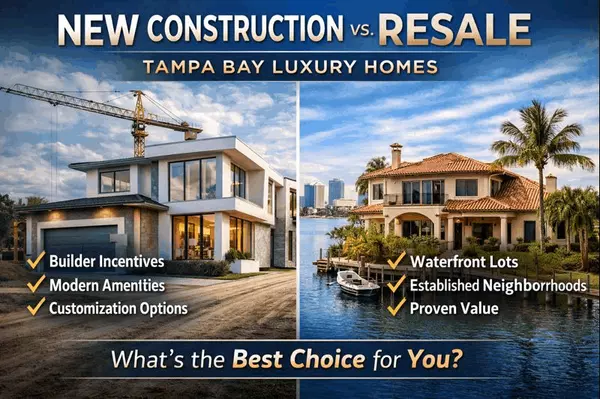
In Tampa Bay in 2026, “buy now” is a smart move when you’re buying the right risk profile—not just the right address. New development projects tend to win on predictability, efficiency, and lock-and-leave ease. Established homes tend to win on land value, neighborhood permanence, and customization control. Your best choice is the one that aligns with how you’ll live in the home and how you’ll manage insurance, HOA governance, and long-term carry costs.
If you want to move from “research” to a confident decision, the next practical step is to compare two or three specific candidates side-by-side using an all-in cost model and a due-diligence checklist tailored to Tampa Bay (insurance, flood, reserves, and resale/rental constraints). That’s where the right local representation and rigorous underwriting typically save you the most time—and the most regret.
Categories
- All Blogs (135)
- 345 Bayshore (3)
- 400 Central (2)
- Apollo Beach (23)
- Arbor Greene (6)
- Avila (38)
- Ballast Point (6)
- Bayshore Beautiful (6)
- Beach Park (34)
- Bel Mar Gardens (4)
- Belleair Beach (5)
- Brandon (10)
- Carrollwood (31)
- Channel District (12)
- Cheval (20)
- Clearwater (34)
- Clearwater Beach (14)
- Cordoba Ranch (5)
- Cory Lake Isles (4)
- Culbreath Isles (23)
- Davis Islands (43)
- Downtown St Petersburg (15)
- Downtown Tampa (45)
- Golfview (18)
- Grand Central at Kennedy (1)
- Gulf Beaches (5)
- Harbour Island (46)
- Home Buying (9)
- Home Improvement (1)
- Home Selling (22)
- Hunters Green (14)
- Hyde Park (37)
- Indian Rocks Beach (8)
- Ladera (7)
- Lakewood Ranch (9)
- lutz (38)
- Luxury Homes (6)
- Madeira Beach (22)
- Marina Pointe (23)
- Market Health Update (20)
- New Suburb Beautiful (3)
- New Tampa (10)
- Odessa (29)
- Old Northeast (2)
- ONE St. Petersburg (1)
- ONE Tampa (3)
- Palma Ceia (7)
- Parkland Estates (4)
- Pendry Tampa (7)
- Pinellas Condos (7)
- Plaza Harbour Island (4)
- Reviews (2)
- Ritz-Carlton Tampa (11)
- Riverview (26)
- Safety Harbor (3)
- Saltaire (1)
- Seminole Heights (25)
- Skypoint (5)
- Snell Isle (20)
- South Tampa (75)
- St Pete Beach (27)
- St Petersburg (48)
- Sunset Park (30)
- Tampa (75)
- Tampa Bay New Construction (2)
- Tampa Bay Real Estate (40)
- Tampa Bay Waterfront (3)
- Tampa Condos (12)
- Tampa Edition (9)
- Tampa Palms (20)
- The Nolen (3)
- The Place Channelside (1)
- Tierra Verde (20)
- Towers of Channelside (2)
- Treasure Island (4)
- Venetian Isles (21)
- Viceroy Clearwater Beach (2)
- Virginia Park (12)
- Waldorf Astoria St Petersburg (4)
- Water Street (21)
- Waterleaf (4)
- Westchase (33)
- Westshore Marina District (26)
- Westshore Yacht Club (6)
- Ybor (8)
Recent Posts