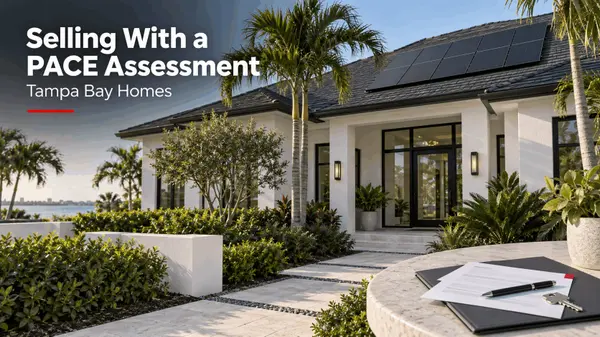
Selling a Tampa Bay Home With Solar Panels: Owned vs. Leased Systems, UCC-1 Filings, and the Closing
How does solar affect selling a home in Tampa Bay?
It comes down to ownership. A system you own outright conveys with the home and can add appraised value, while a leased system or power purchase agreement is third-party property that adds nothing to the appraisal and has to be transferred to your buyer or bought out. Any UCC-1 financing statement a solar company filed against the home must be subordinated, terminated, or paid off before the title can close clean — so the first move is confirming exactly which kind of solar you have.
Solar shows up on more Tampa Bay roofs every year — from single-family streets in Palma Ceia and Virginia Park to the newer suburban builds in Westchase, K-Bar Ranch, and Apollo Beach. When it comes time to sell, owners tend to assume the panels are a clean selling point. Sometimes they are. Sometimes they're the thing that snags the closing.
The difference almost always traces back to one question: do you own the system, or does someone else? Get that answer straight before you list, because it decides whether solar helps your price or becomes a paperwork problem in the final week.
First, figure out which kind of solar you actually have
There are four common arrangements, and they behave very differently at the closing table.
- Owned outright. You paid cash or paid off the solar loan. The panels are yours, they convey with the home like any other fixture, and there's no third party in the deal. This is the cleanest case.
- Owned but financed (a solar loan). You own the panels, but a lender financed them and likely filed a lien. The remaining balance has to be paid off — usually from your sale proceeds — and the lien released before closing, the same way you'd satisfy a second mortgage.
- Leased or under a power purchase agreement (PPA). A solar company owns the system. You either pay a fixed monthly lease or buy the power it produces by the kilowatt-hour. The buyer generally has to qualify to take over that contract, or you buy it out.
- PACE financing. You financed the system through a Property Assessed Clean Energy program under F.S. 163.08, and you repay it as a non-ad-valorem assessment on your property tax bill. That creates a lien that rides with the property, and many conventional lenders won't fund a purchase while it sits in first position — so it usually has to be paid off at closing.
If you're not certain which bucket you're in, pull your original solar contract and a recent mortgage or title document. The contract language — "lease," "power purchase agreement," "loan," or "assessment" — tells you most of what you need to know.
The UCC-1 filing is what shows up on your title
When a system is leased, financed, or sold under a PPA, the solar company usually protects its interest by filing a UCC-1 financing statement. Sometimes it's filed as a fixture filing tied to your property's legal description, which means the title search picks it up.
That filing signals to the buyer, the buyer's lender, and the title company that a third party has a claim on equipment attached to the house. Before the deal can close with clear title, that UCC-1 has to be subordinated, terminated, or satisfied so the buyer's new mortgage stays in first-lien position. Fannie Mae's guidelines are explicit on this point, which is why a lender's title company won't simply look past it.
An unresolved UCC-1 is one of the most common reasons a solar home sale slips its closing date. The fix is rarely complicated, but it takes time — and time is exactly what a firm closing date doesn't give you. This is the same lien-clearance discipline I cover in my walkthrough of title insurance and reading the title commitment.
Owned vs. leased changes what the system is worth
Ownership doesn't just affect the paperwork — it affects the appraisal.
Owned panels can add value. Research from Lawrence Berkeley National Laboratory has found that homes with owned solar tend to sell for a measurable premium — directionally in the neighborhood of a few percent — though the figure varies widely by market, system size, and buyer. An owned system that's paid off and free of any lien can be included in the appraised value.
Leased panels and PPAs generally add nothing to the appraisal. Because a third party owns the equipment, lenders treat it as personal property, not part of the real estate. It can't be counted toward value, and in some cases the monthly lease payment counts against the buyer's debt-to-income ratio — which can shrink the pool of buyers who qualify.
There's a Florida wrinkle that works in an owner's favor. Under F.S. 193.624, the added value a residential renewable energy device brings to your home is excluded from your assessed value through 2037 — so owned solar can raise what the home is worth without raising the buyer's property tax bill. That's a genuine talking point, and it ties into how assessed value works on your first Florida property tax bill after closing.
If the system is leased or financed, you have three paths
When a third party still has an interest in the panels, your options at sale come down to three.
- Transfer the contract to the buyer. The solar company has to consent, and the buyer typically goes through a credit check, signs a transfer agreement, and may pay a transfer fee. Start this early — the company's process can run weeks, and the buyer has to actually want the system on those terms.
- Buy out the contract. You pay the remaining lease or loan balance, often using sale proceeds, and the solar company releases the UCC-1. The home then sells with the panels owned and free of any third-party claim — frequently the smoothest outcome for a luxury buyer who doesn't want to inherit a monthly contract.
- Have the system removed. If a transfer and a buyout both fall through, you can ask the company to remove the panels. It's the least common path, and it comes with cost and roof-repair considerations, but it's a release valve when the contract terms are a dealbreaker.
What the buyer inherits — net metering and the interconnection
Solar in Tampa Bay only pencils out because of net metering. Florida's investor-owned utilities — Tampa Electric, Duke Energy Florida, and FPL — currently credit residential solar customers at the full retail rate for excess power sent to the grid. That retail-rate framework is set by the Florida Public Service Commission, while each utility's own program guidelines generally size a residential system to no more than about 115% of the home's historical use. Both can change, so treat the current structure as today's framework, not a guarantee.
The practical point for a sale: the interconnection and net-metering agreement is in your name, and the buyer needs to transfer it into theirs. It's a routine step, but it belongs on the closing checklist alongside the contract transfer so the new owner doesn't lose the credit they're counting on.
One more piece of 2026 context worth knowing: the federal residential solar tax credit (Section 25D) ended for systems placed in service after December 31, 2025. That doesn't claw back anything you already claimed, but it does mean a buyer can't expect a fresh federal credit on your existing system — which is one more reason an owned, paid-off array tends to be an easier sell than a contract someone has to assume.
Disclose it — a solar lease is a material fact
An active lease, a PPA, a solar loan, or a UCC lien is a material fact, and it belongs on your Seller's Property Disclosure. So do the system's age, capacity, and warranty details. Leaving it off isn't a shortcut — under Florida law, a known fact that materially affects value and isn't readily observable has to be disclosed, and a missed disclosure can follow you after closing. I break down that duty in my guide to reviewing the Seller's Property Disclosure.
The cleanest approach is to get ahead of it. Assemble a solar package before you list: the original contract, the monitoring login and recent production data, warranty documents, and the payoff or buyout figure if there's a balance. Handing a buyer a complete file removes friction and keeps the system framed as an asset rather than an unknown.
A seller's solar checklist
Before you list a Tampa Bay home with solar, work through these:
- Confirm ownership — owned outright, solar loan, lease/PPA, or PACE.
- Request a UCC search or payoff/buyout quote from the solar company early.
- Decide your path on any leased or financed system — transfer, buyout, or removal.
- Gather the contract, warranty, production history, and monitoring access.
- Disclose the system and any lien on the Seller's Property Disclosure.
- Put the net-metering and interconnection transfer on the closing checklist.
Handled in that order, solar is an advantage. Handled late, it's the line item that moves your closing. If you're getting ready to sell, this is exactly the kind of detail I sort out with sellers before we go live — see how I approach the whole process on my sell-your-home page.
Frequently Asked Questions
Can I sell my Tampa Bay house if it has leased solar panels?
Yes. You either transfer the lease or PPA to a buyer who qualifies with the solar company, buy out the remaining balance so the panels convey free and clear, or arrange to have the system removed. The key is starting the process early, because the solar company's approval can take weeks.
What is a UCC-1 filing on solar panels?
It's a financing statement a solar company files to protect its interest in a leased or financed system, sometimes recorded as a fixture filing against your property. It shows up on the title search and must be subordinated, terminated, or paid off before a buyer's lender will close in first-lien position.
Do owned solar panels add value when selling in Florida?
Owned, paid-off panels can be included in the appraised value and tend to sell at a modest premium, though the amount varies by market and buyer. Florida adds a bonus: under F.S. 193.624, the added value is excluded from your property tax assessment through 2037, so it doesn't raise the buyer's tax bill.
Does a solar lease hurt my home's appraisal?
A leased system or PPA doesn't add to the appraised value because a third party owns the equipment, and the monthly payment can count against a buyer's debt-to-income ratio. That's why buying out the contract before closing often makes the home easier to sell.
What happens to net metering when I sell a Tampa Bay solar home?
The interconnection and net-metering agreement is tied to your account, so the buyer transfers it into their name as part of closing. Florida's investor-owned utilities currently credit excess solar at the retail rate, but that's set by the Public Service Commission and can change over time.
Selling a home with solar isn't hard — but it rewards sellers who sort out ownership, liens, and the contract before the closing date is locked, not after. Owned and clean, the panels are a selling point. Leased and unaddressed, they're the thing that stalls the deal in the final week.
If you're thinking about selling a Tampa Bay home with solar — or just trying to understand where the market stands — a direct conversation usually clears more up than another search. I coordinate with your solar company, lender, and title company so the system is handled before we list, not patched at the table.
About Shane Vanderson
Shane Vanderson is a License Partner and Broker Associate with Engel & Völkers South Tampa, licensed since 2012 representing buyers and sellers across Tampa Bay's high-end market. He specializes in South Tampa, Harbour Island, Hyde Park, Sunset Park, Beach Park, Virginia Park, Culbreath Isles, Westshore Marina District, Bayshore Beautiful, Davis Islands, Avila, Safety Harbor, Odessa, Lutz, Westchase, Riverview, Venetian Isles, Old Northeast, Snell Isle, the Gulf Beaches, Downtown St. Petersburg, Downtown Tampa waterfront, and luxury condominiums, and holds membership in Engel & Völkers' Professional Athlete Advisory. Connect with Shane at shanevanderson.com or 813-205-5430.
This article is general information for Tampa Bay buyers and sellers, not legal, tax, or financial advice. Solar contracts, lien releases, and net-metering rules depend on your specific situation and can change — confirm details with your solar provider, lender, title company, and a licensed Florida professional. Engel & Völkers South Tampa supports Equal Housing Opportunity.Categories
- All Blogs (208)
- 345 Bayshore (4)
- 400 Central (3)
- Apollo Beach (24)
- Arbor Greene (6)
- Art House (1)
- Avila (37)
- Ballast Point (16)
- Bayshore Beautiful (15)
- Beach Park (48)
- Bel Mar Gardens (7)
- Belleair Beach (8)
- Brandon (15)
- Carrollwood (35)
- Channel District (7)
- Cheval (22)
- Clearwater (50)
- Clearwater Beach (26)
- Cordoba Ranch (6)
- Cory Lake Isles (5)
- Culbreath Isles (26)
- Davis Islands (55)
- Downtown St Petersburg (29)
- Downtown Tampa (52)
- Golfview (20)
- Grand Central at Kennedy (2)
- Gulf Beaches (23)
- Harbour Island (52)
- Hillsborough (2)
- Home Buying (70)
- Home Improvement (6)
- Home Selling (71)
- Hotel ORA (2)
- Hunters Green (13)
- Hyde Park (48)
- Hyde Park House (3)
- Indian Rocks Beach (14)
- Ladera (8)
- Lakewood Ranch (7)
- lutz (43)
- Luxury Homes (39)
- Madeira Beach (32)
- Marina Pointe (20)
- New Suburb Beautiful (7)
- New Tampa (15)
- Odessa (37)
- Old Northeast (11)
- ONE St. Petersburg (5)
- ONE Tampa (5)
- Palma Ceia (20)
- Parkland Estates (8)
- Pasco (1)
- Pendry Tampa (10)
- Pinellas Condos (15)
- Plaza Harbour Island (5)
- Professional Athlete Advisory (3)
- Reviews (2)
- Ritz-Carlton Tampa (16)
- Riverview (26)
- Safety Harbor (7)
- Saltaire (5)
- Seminole Heights (23)
- Skypoint (6)
- Snell Isle (30)
- South Tampa (104)
- St Pete Beach (29)
- St Petersburg (74)
- Sunset Park (40)
- Tampa (93)
- Tampa Bay New Construction (7)
- Tampa Bay Real Estate (27)
- Tampa Bay Waterfront (8)
- Tampa Condos (19)
- Tampa Edition (8)
- Tampa Palms (17)
- The Nolen (2)
- The Place Channelside (2)
- Tierra Verde (21)
- Treasure Island (13)
- Venetian Isles (24)
- Viceroy Clearwater Beach (3)
- Virginia Park (19)
- Waldorf Astoria St Petersburg (4)
- Water Street (17)
- Waterleaf (4)
- Westchase (33)
- Westshore Marina District (21)
- Westshore Yacht Club (5)
- Ybor (8)
Recent Posts