Top Waterfront Homes vs High-Rise Condos in Tampa Bay: South Tampa vs Downtown St. Pete Comparison (Decision Guide)
Should you buy a waterfront home in South Tampa or a high-rise condo in Downtown St. Pete—and which lifestyle, costs, and risks fit you best?
Waterfront homes in South Tampa maximize privacy, lot control, and boating access but bring higher maintenance, insurance, and storm risk. Downtown St. Pete high-rises trade yard/boat access for walkability, amenities, and lock-and-leave ease.
Introduction
If you’re shopping Tampa Bay at the decision stage, you’re likely past “Tampa vs St. Pete” and deep into the real question: what kind of life do you want to live day-to-day—and what tradeoffs are you willing to own? On paper, South Tampa waterfront homes and Downtown St. Pete high-rise condos can sit in the same price band. In practice, they behave like totally different assets, with different risk profiles, time commitments, and resale audiences.
This matters now because the luxury market has gotten more “selective.” Buyers aren’t just paying for zip codes—they’re paying for convenience, stability of monthly costs, and how a property performs under Florida’s realities: wind, flood, insurance volatility, HOA governance, and increasingly strict building-reserve requirements. If you choose the right match, you’ll feel it every morning—less friction, fewer surprises, more enjoyment. Choose the wrong match, and even a beautiful home can feel like an expensive compromise.
Below is a practical, buyer-oriented comparison designed to help you decide confidently between South Tampa waterfront single-family and Downtown St. Pete high-rise condo living.
1) Lifestyle Fit: Privacy & Space vs Walkability & “Lock-and-Leave” Ease
Your best choice starts with how you actually live—not how you vacation.
South Tampa waterfront homes typically win when you want:
- Control and privacy: Your own lot, your own rules (within city/county regs), fewer shared walls.
- Outdoor living: Pool, patio, entertaining space, pets, gardens, and storage that condos can’t match.
- Boating-first priorities: If your goal is a lift, a dock, and quick water access, single-family waterfront is often the more straightforward path.
But that control comes with responsibility. When you own a waterfront home, you’re effectively the property manager. Even with vendors, you’re the decision-maker for roof cycles, seawall maintenance, pest control, HVAC, landscaping, pool service, and storm prep.
Downtown St. Pete high-rise condos typically win when you want:
- Walkable, urban living: Coffee, restaurants, waterfront parks, museums, and events without getting in the car.
- Lock-and-leave simplicity: Ideal if you travel, split time between cities, or want a second home.
- Amenity-driven convenience: Fitness centers, pools, security/concierge (in some buildings), package rooms, and shared social spaces.
The tradeoff is that your daily environment is governed by the building: neighbors, rules, common-area condition, elevator reliability, and the HOA board’s financial decisions. You’re buying into a managed ecosystem—which can be a huge benefit if it’s well-run, and a headache if it isn’t.
Decision shortcut:
- If your “best day” includes dock → boat → sunset → backyard, South Tampa waterfront is usually the emotional and functional fit.
- If your “best day” includes walk → brunch → gallery → waterfront park → dinner, Downtown St. Pete high-rise life tends to deliver more consistently.
2) True Cost of Ownership: The Monthly Number You See vs the Bills You Don’t
At this price level, the purchase price rarely tells the truth by itself. You want to compare predictability as much as total cost.
South Tampa waterfront home costs to model
Expect a mix of recurring and “lumpy” expenses that can spike:
- Homeowners insurance (often the swing factor; coastal exposure can materially change premiums)
- Flood insurance depending on elevation, flood zone, lender requirements, and your own risk tolerance
- Maintenance reserves: roofs, windows/doors, exterior paint, pool equipment, irrigation, tree work
- Waterfront-specific items: seawall repairs, cap replacement, dock pilings, lift maintenance, saltwater corrosion
Even if your monthly cash flow looks fine, the capital expenditure curve can be steep. A well-maintained waterfront home is incredible—an under-maintained one can turn into a constant project.
Downtown St. Pete high-rise condo costs to model
Condos concentrate costs into:
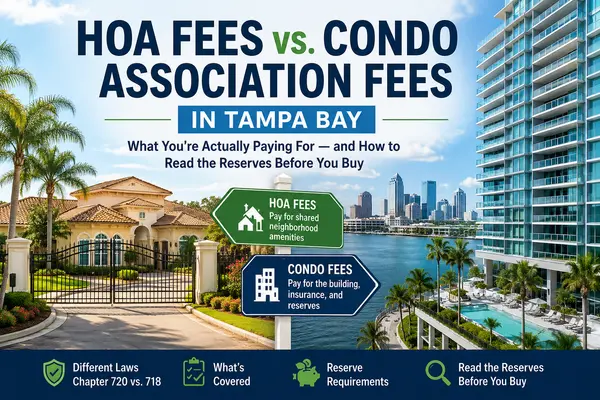
- HOA/COA dues (often include exterior insurance elements, building maintenance, amenities, staff, reserves—varies by building)
- Special assessments (the big “unknown” if reserves are weak or major projects hit)
- Insurance for your unit (HO-6), plus potential “loss assessment” coverage
- Parking/storage fees (sometimes included, sometimes separate)
Condos can be easier to budget month-to-month, but only if the HOA is financially healthy. A low monthly fee can be a red flag if reserves and deferred maintenance don’t match the building’s age and complexity.
Actionable budgeting tip:
When you compare a South Tampa waterfront home to a St. Pete condo, don’t just compare “PITI vs HOA.” Ask yourself:
- Which one gives me more predictable costs for the next 5 years?
- Which one could surprise me with a five-figure bill?
Both can—just in different ways.
3) Risk & Resilience: Flood, Wind, Building Condition, and Governance
In Tampa Bay, “risk” is not abstract—it’s underwriting, inspections, and future resale confidence.
South Tampa waterfront: risk is property-specific
You’ll want to evaluate:
- Elevation and flood exposure: Not all “waterfront” is equal. Two streets apart can mean very different flood dynamics.
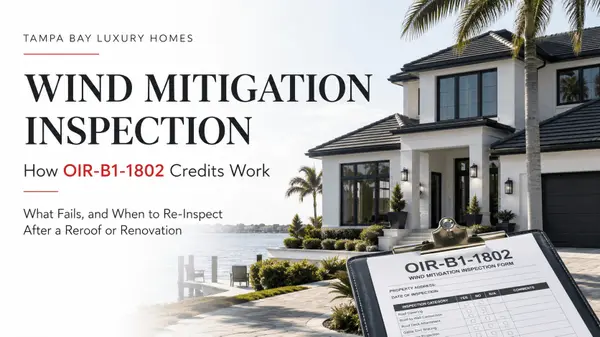
- Wind mitigation features: roof shape, attachment, secondary water barrier, impact windows/doors
- Seawall and dock integrity: age, permits, visible cracking, settlement, tieback condition (as applicable)
- Drainage and grading: how water moves on and off your lot during heavy rain
Your due diligence is heavily about site-specific reality. One waterfront home can be a fortress; another can be a recurring insurance and repair problem.
Downtown St. Pete high-rise: risk is building/systemic
Your focus shifts to:
- HOA financial health: reserves, reserve studies (if available), delinquency rates, and budget discipline
- Building maintenance history: roof/common-area waterproofing, concrete work, windows, balconies, elevators, mechanical systems
- Rules that affect your lifestyle and value: rental restrictions, pet limits, renovation policies, move-in/out rules
- Assessment likelihood: upcoming projects + inadequate reserves = potential assessment pressure
In a condo, you’re buying a shared outcome. Even if your unit is perfect, building-level issues affect everything from financing options to buyer demand when you sell.
Actionable due diligence checklist (condo):
- Review the last 12–24 months of HOA minutes for recurring problems (leaks, elevator issues, contractor disputes).
- Ask specifically about planned capital projects in the next 24–36 months.
- Request the current budget, reserves, and any reserve study (or explanation if not available).
- Confirm rental policy (minimum lease term, cap, waitlist) if flexibility matters.
Actionable due diligence checklist (waterfront home):
- Order wind mitigation and 4-point inspections early (insurance shopping often depends on them).
- Investigate seawall permits/repairs history and get a marine contractor opinion if age is unknown.
- Validate drainage patterns after heavy rain if possible (neighbors can be informative).
- Confirm dock/lift legality and permitting—don’t assume grandfathering.
4) Resale & Value Behavior: Who Buys After You—and Why That Matters
At the decision stage, you’re not just buying for today. You’re choosing your future buyer pool.
South Tampa waterfront resale dynamics
Your next buyer is often someone prioritizing:
- waterfront access and privacy
- lot size and a custom-home trajectory
- school proximity or commute patterns (depending on the micro-area)
- the “trophy” quality of water frontage
This can support strong long-term desirability, but it’s more sensitive to:
- condition of seawalls/docks and the cost to cure
- insurance availability and premium swings
- functional obsolescence (older floorplans, low ceilings, limited hurricane protection)
A well-elevated, well-updated waterfront home with strong storm readiness tends to command a premium because it reduces uncertainty.
Downtown St. Pete high-rise resale dynamics
Your next buyer is often someone prioritizing:
- downtown lifestyle and walkability
- secure parking, views, amenities
- low-maintenance, part-time living
- modern finishes and a well-managed building
Condos can be more sensitive to:
- HOA reputation and financial strength
- rental restrictions (these can shrink or strengthen demand depending on the buyer)
- building age and looming capex cycles
Concrete example of buyer-pool thinking:
If you might relocate in 3–7 years, a condo in a highly walkable downtown core can be easier to position to busy professionals and second-home buyers—if the building is well-run. A waterfront home can sell exceptionally well too, but buyers will scrutinize inspection and insurance more intensely because the downside risk can be higher.
FAQ Section
1) Is South Tampa or Downtown St. Pete better for “luxury living”?
It depends on what “luxury” means to you. If luxury is space, privacy, and private water access, South Tampa usually wins. If luxury is walkable convenience, views, and amenities with minimal upkeep, Downtown St. Pete high-rise condos often feel more luxurious day-to-day.
2) Which is safer financially: a waterfront home or a high-rise condo?
Neither is automatically safer. Waterfront homes can bring insurance and maintenance volatility, while condos can bring special assessment and HOA governance risk. The “safer” option is the one with the cleaner due diligence: strong inspections/mitigation for the home, or strong reserves/minutes/maintenance history for the condo.
3) What should you review before making an offer on a Downtown St. Pete condo?
At minimum: HOA budget and reserves, recent financials, condo docs and rules, recent HOA minutes, building maintenance history, and any planned projects. If anything looks unclear, you want answers before your inspection and contingency windows narrow.
Closing
If you’re torn between South Tampa waterfront homes and Downtown St. Pete high-rise condos, the cleanest decision usually comes from two filters: (1) the lifestyle you’ll use weekly, not occasionally, and (2) the risk you can genuinely tolerate—insurance/maintenance on one side, HOA/assessment exposure on the other.
If you share what matters most (boating vs walkability, full-time vs part-time, privacy vs amenities, budget predictability vs property control), you can narrow to the right micro-locations and building/home criteria—and then schedule only the showings that have a real chance of being “the one.”
Categories
- All Blogs (193)
- 345 Bayshore (4)
- 400 Central (2)
- Apollo Beach (24)
- Arbor Greene (6)
- Avila (43)
- Ballast Point (12)
- Bayshore Beautiful (15)
- Beach Park (43)
- Bel Mar Gardens (7)
- Belleair Beach (9)
- Brandon (12)
- Carrollwood (36)
- Channel District (12)
- Cheval (22)
- Clearwater (48)
- Clearwater Beach (27)
- Cordoba Ranch (7)
- Cory Lake Isles (5)
- Culbreath Isles (24)
- Davis Islands (54)
- Downtown St Petersburg (31)
- Downtown Tampa (59)
- Golfview (20)
- Grand Central at Kennedy (4)
- Gulf Beaches (14)
- Harbour Island (59)
- Hillsborough (1)
- Home Buying (30)
- Home Improvement (5)
- Home Selling (39)
- Hotel ORA (3)
- Hunters Green (15)
- Hyde Park (47)
- Hyde Park House (3)
- Indian Rocks Beach (14)
- Ladera (9)
- Lakewood Ranch (7)
- lutz (44)
- Luxury Homes (19)
- Madeira Beach (33)
- Marina Pointe (22)
- Market Health Update (20)
- New Suburb Beautiful (6)
- New Tampa (16)
- Odessa (38)
- Old Northeast (9)
- ONE St. Petersburg (4)
- ONE Tampa (6)
- Palma Ceia (16)
- Parkland Estates (8)
- Pasco (1)
- Pendry Tampa (8)
- Pinellas Condos (11)
- Plaza Harbour Island (4)
- Professional Athlete Advisory (4)
- Reviews (2)
- Ritz-Carlton Tampa (15)
- Riverview (27)
- Safety Harbor (7)
- Saltaire (4)
- Seminole Heights (28)
- Skypoint (5)
- Snell Isle (32)
- South Tampa (100)
- St Pete Beach (30)
- St Petersburg (68)
- Sunset Park (39)
- Tampa (95)
- Tampa Bay New Construction (5)
- Tampa Bay Real Estate (35)
- Tampa Bay Waterfront (9)
- Tampa Condos (17)
- Tampa Edition (8)
- Tampa Palms (21)
- The Nolen (2)
- The Place Channelside (3)
- Tierra Verde (20)
- Towers of Channelside (1)
- Treasure Island (10)
- Venetian Isles (23)
- Viceroy Clearwater Beach (3)
- Virginia Park (17)
- Waldorf Astoria St Petersburg (4)
- Water Street (19)
- Waterleaf (4)
- Westchase (39)
- Westshore Marina District (23)
- Westshore Yacht Club (6)
- Ybor (9)
Recent Posts