Surveys, Easements, and Encroachments at a Tampa Bay Closing: What the Boundary Survey Reveals — and Who Fixes It
What does a boundary survey catch before a Tampa Bay closing?
A boundary survey maps your legal property lines, plots every recorded easement, and flags encroachments — fences, driveways, pool decks, or docks that cross a line in either direction. In Florida, the buyer typically orders and pays for the survey, and any lender will require a current one. If the survey reveals an encroachment or an improvement violating a setback or easement, the standard Florida contract treats it as a title defect the seller generally must cure before closing. Skipping the survey — common among cash buyers — means your title policy usually carries a survey exception that excludes exactly these problems from coverage.
A week before closing, the survey comes back showing the neighbor's fence sitting three feet inside your line — or your soon-to-be pool deck sitting two feet inside theirs. This is one of the most common late-stage surprises in a Florida transaction, and how it gets handled depends on paperwork most buyers have never read.
Here's the part that catches high-end buyers specifically: when there's no mortgage, there's no lender forcing the issue. Financed deals require a current survey. Cash deals don't. I've watched cash buyers on premium waterfront lots wave off a survey to save a modest fee on a multi-million-dollar purchase. That's backwards. The higher the land value, the more expensive every foot of boundary becomes, and buyer representation that pushes for the survey early is cheap insurance.
What the survey shows — and what it doesn't
A Florida boundary survey, performed by a state-licensed surveyor and mapper, gives you a signed drawing of:
- The legal boundary lines and corner monuments, matched against the recorded legal description
- All improvements — house, pool, deck, driveway, fence, outbuildings, seawall, dock — and where they sit relative to the lines
- Recorded easements and setback lines plotted on the drawing, not just listed in text
- Encroachments in both directions — their improvements over your line, and yours over theirs
Two things it doesn't do. It isn't an elevation certificate — that's a separate document showing your structure's height relative to base flood elevation for flood insurance rating. And it isn't a title search — the surveyor plots what the title work and field evidence reveal, which is why your title company and surveyor need to be working from the same commitment.
Residential boundary surveys in the Tampa Bay area typically run from several hundred dollars into the low thousands, with waterfront parcels, large lots, and older platted neighborhoods like Hyde Park or Palma Ceia — where original monuments may be long gone — at the higher end. Order it early in your inspection period. Turnaround is commonly a couple of weeks, and it can stretch when storm-recovery work has surveyors booked.
There's a second reason the survey matters even when nothing looks wrong: title insurance. Without a current survey the title company can accept, your owner's policy will generally include a survey exception — standard language excluding coverage for anything an accurate survey would have shown: boundary overlaps, encroachments, unrecorded easement use. On financed deals, the lender's required endorsement can't be issued without a current survey for the same reason. Pay for the survey and you can have that exception removed or narrowed, which converts boundary risk from your problem into the underwriter's.
Easements: the rights other people hold over your land
An easement is a recorded right for someone else — a utility, a neighboring owner, a drainage district, the public — to use a defined strip of your property. The survey plots them; the title commitment lists them. In the Tampa Bay area you'll most often see:
- Utility easements along rear and side lot lines for power, water, sewer, cable, and reclaimed water
- Drainage easements, which do heavy lifting in a flat, wet region — swales, outfalls, and retention flow paths that must stay unobstructed
- Access or ingress-egress easements, including shared driveways and flag-lot access strips
- Right-of-way and sidewalk easements along the street frontage
The practical question isn't whether easements exist — nearly every lot has them — it's what they prevent you from building. A ten-foot drainage easement across the back of a Sunset Park lot can kill the pool placement you sketched during the showing. A utility easement can sit exactly where the outdoor kitchen, the casita, or the whole-home generator was supposed to go, and the utility can generally require you to remove improvements built inside it. If your plans for the property involve adding square footage, a pool, or a major landscape build, read the survey against those plans before your inspection period ends — not after closing.
Florida law also recognizes easements that don't appear in any deed, including implied easements and the statutory way of necessity under Chapter 704, Florida Statutes, for landlocked parcels. Those are rare in established South Tampa neighborhoods, but they're one more reason the survey and title commitment get read together.
Encroachments — and how they get fixed before closing
An encroachment is a physical improvement across a boundary, setback, or easement line. The Tampa Bay classics: fences set by eye decades ago, driveway edges, pool decks and screen enclosures built to the line, AC pads, and — on waterfront lots — seawall returns and dock structures. Storm rebuilding after Helene and Milton added a fresh crop, as fences, equipment pads, and generators went back up quickly and not always exactly where they'd been.
Under the Florida Realtors/Florida Bar contract used in most Tampa Bay deals, survey problems are handled through the title-defect machinery: if the survey shows an encroachment or a violation of restrictions or setbacks, the buyer delivers written notice within a short contractual window — typically five days after receiving the survey, and no later than closing — and the matter is treated as a title defect the seller has an opportunity to cure. This is one more deadline inside the same clock I walk through in what happens after you accept an offer on a Tampa Bay home, and it's why a survey ordered in week one beats a survey ordered in week four.
The cure usually takes one of five paths, roughly in order of preference:
- Remove or relocate the offending improvement — the clean fix for a fence or shed
- A recorded encroachment agreement between the owners, letting the improvement remain on defined terms that bind future buyers
- A boundary line agreement re-establishing an uncertain line where surveys genuinely conflict
- Affirmative title coverage, where the underwriter reviews a minor, long-standing encroachment and insures over it
- A quiet title action — litigation, the last resort, and rarely something you want to inherit as a buyer
Which path fits is a legal and negotiating question, and on estate-caliber properties it's worth involving a real estate attorney alongside the title company. What you shouldn't do is close with a known, unresolved encroachment and a survey exception in your policy — that combination means you bought the dispute.
Waterfront lines work differently
On Davis Islands, Culbreath Isles, Snell Isle, or any Tampa Bay waterfront lot, the survey gets more interesting, because one of your boundaries is water.
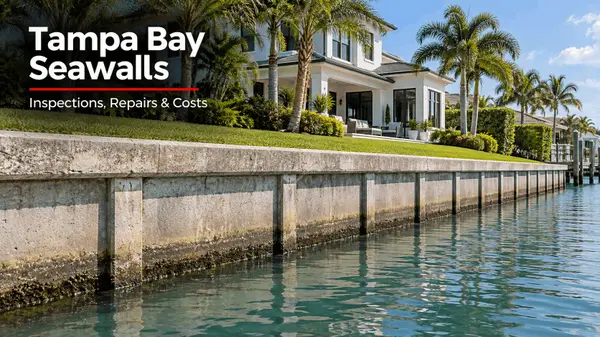
On tidal water, private ownership generally ends at the mean high-water line — waterward of that is sovereignty submerged land held by the State of Florida. Your dock sits on state-owned bottom, occupied under some form of state authorization, and your rights to reach the water are riparian rights recognized under Florida law rather than fee ownership of the bay bottom. A proper waterfront survey shows the mean high-water line, the seawall, and the dock and lift structures — and where they sit relative to your riparian area, because side riparian lines don't always match your upland lot lines extended. A dock angled into a neighbor's riparian corridor is an encroachment dispute with a marine flavor, and it surfaces at exactly the wrong time: closing.
That's also why waterfront due diligence runs deeper than the survey alone — dock permits, seawall condition, and what actually transfers are their own checklist, which I've covered in buying a boat slip or dock with a Tampa Bay waterfront home. And if you're planning to rebuild or expand on a Gulf-front parcel, the state's coastal construction rules add another regulatory line to the drawing — see how CCCL permits work for Tampa Bay waterfront.
Frequently Asked Questions
Who pays for the survey when buying a home in Florida?
The buyer typically orders and pays for the boundary survey as part of closing costs, though it's negotiable in the contract. If a survey is needed to cure a title problem the seller is obligated to fix, the seller commonly bears that cost. On financed purchases the lender requires a current survey regardless of who pays.
Can I use the seller's old survey instead of ordering a new one?
Sometimes — if the title company will accept it, usually together with a seller's affidavit stating nothing has changed since it was prepared. But any added fence, pool, addition, or storm repair since that survey makes it unreliable, and the underwriter decides what's acceptable, not the parties. On a high-value or waterfront purchase, a new survey is the conservative call.
What happens if the survey shows the neighbor's fence on my side of the line?
Under the standard Florida contract, you deliver written notice — typically within five days of receiving the survey and no later than closing — and the encroachment is treated as a title defect for the seller to address. Fixes range from moving the fence to a recorded encroachment agreement to affirmative title coverage. Closing with it unresolved means the problem, and the negotiation, become yours.
Does title insurance cover boundary and encroachment problems?
Only if the survey exception is removed or narrowed, which requires giving the title company a current, acceptable survey. Without that, the standard owner's policy excludes matters an accurate survey would have revealed — which is most boundary and encroachment risk.
Is a boundary survey the same as an elevation certificate?
No. The boundary survey establishes property lines, improvements, easements, and encroachments. An elevation certificate documents the structure's elevation against base flood elevation for flood-insurance rating. Tampa Bay waterfront and flood-zone buyers frequently need both, and they're separate engagements.
The survey is a modest line item that resolves the largest single question in the purchase: what, exactly, you're buying. Order it early, read it against your plans for the property, and don't close around an open boundary problem.
If you're weighing a Tampa Bay purchase — waterfront or otherwise — and want the due-diligence sequence run right from day one, a direct conversation usually clears more up than another search.
About Shane Vanderson
Shane Vanderson is a License Partner and Broker Associate with Engel & Völkers South Tampa, licensed since 2012 representing buyers and sellers across Tampa Bay's luxury market. He specializes in South Tampa, Harbour Island, Hyde Park, Sunset Park, Beach Park, Virginia Park, Culbreath Isles, Westshore Marina District, Bayshore Beautiful, Davis Islands, Avila, Safety Harbor, Odessa, Lutz, Westchase, Riverview, Venetian Isles, Old Northeast, Snell Isle, Gulf Beaches, Downtown St Petersburg, Downtown Tampa waterfront, and luxury condominiums, and holds membership in Engel & Völkers' Professional Athlete Advisory. Connect with Shane at shanevanderson.com or 813-205-5430.Categories
- All Blogs (217)
- 345 Bayshore (4)
- 400 Central (3)
- Apollo Beach (25)
- Arbor Greene (6)
- Art House (1)
- Avila (37)
- Ballast Point (16)
- Bayshore Beautiful (15)
- Beach Park (49)
- Bel Mar Gardens (7)
- Belleair Beach (8)
- Brandon (15)
- Carrollwood (36)
- Channel District (7)
- Cheval (22)
- Clearwater (51)
- Clearwater Beach (27)
- Cordoba Ranch (6)
- Cory Lake Isles (5)
- Culbreath Isles (27)
- Davis Islands (56)
- Downtown St Petersburg (29)
- Downtown Tampa (53)
- Golfview (20)
- Grand Central at Kennedy (2)
- Gulf Beaches (23)
- Harbour Island (53)
- Hillsborough (2)
- Home Buying (74)
- Home Improvement (6)
- Home Selling (76)
- Hotel ORA (2)
- Hunters Green (13)
- Hyde Park (48)
- Hyde Park House (3)
- Indian Rocks Beach (14)
- Ladera (8)
- Lakewood Ranch (7)
- lutz (43)
- Luxury Homes (42)
- Madeira Beach (33)
- Marina Pointe (21)
- New Suburb Beautiful (7)
- New Tampa (15)
- Odessa (38)
- Old Northeast (11)
- ONE St. Petersburg (5)
- ONE Tampa (6)
- Palma Ceia (20)
- Parkland Estates (8)
- Pasco (1)
- Pendry Tampa (11)
- Pinellas Condos (16)
- Plaza Harbour Island (5)
- Professional Athlete Advisory (3)
- Reviews (2)
- Ritz-Carlton Tampa (16)
- Riverview (27)
- Safety Harbor (7)
- Saltaire (5)
- Seminole Heights (23)
- Skypoint (6)
- Snell Isle (30)
- South Tampa (107)
- St Pete Beach (30)
- St Petersburg (75)
- Sunset Park (41)
- Tampa (95)
- Tampa Bay New Construction (7)
- Tampa Bay Real Estate (27)
- Tampa Bay Waterfront (9)
- Tampa Condos (21)
- Tampa Edition (8)
- Tampa Palms (17)
- The Nolen (2)
- The Place Channelside (2)
- Tierra Verde (21)
- Treasure Island (14)
- Venetian Isles (24)
- Viceroy Clearwater Beach (3)
- Virginia Park (19)
- Waldorf Astoria St Petersburg (5)
- Water Street (17)
- Waterleaf (4)
- Westchase (33)
- Westshore Marina District (21)
- Westshore Yacht Club (6)
- Ybor (8)
Recent Posts